

Structural vs. Wildland Firefighter Helmet: What’s the Difference?
Fire rescue scenarios are divided into two categories, namely Structural firefighting and wildland firefighting. The operation environment and risk characteristics of the two are very different, but many practitioners and purchasers are often confused.Many people think that fire fighting equipment can be used interchangeably, in fact, there is no small safety hazard.Structural firefighting is aimed at confined space fires such as urban buildings and workshops, while wildland firefighting is responsible for outdoor fires such as mountains and grasslands. The requirements for protective equipment are completely different in different scenes.
The fire conditions, fall risks and operating methods of the two fire scenarios are different, which is particularly evident in the core protective equipment fire helmet.Structural firefighter helmets focus on impact resistance and high temperature resistance, which can cope with building collapse and high temperature ignition risk. Wildland firefighter helmet are mainly lightweight, breathable and fire-proof, suitable for complex mountain terrain.This article compares the two types of fire fighting modes and special helmets in detail to help you accurately select and adapt the scene.
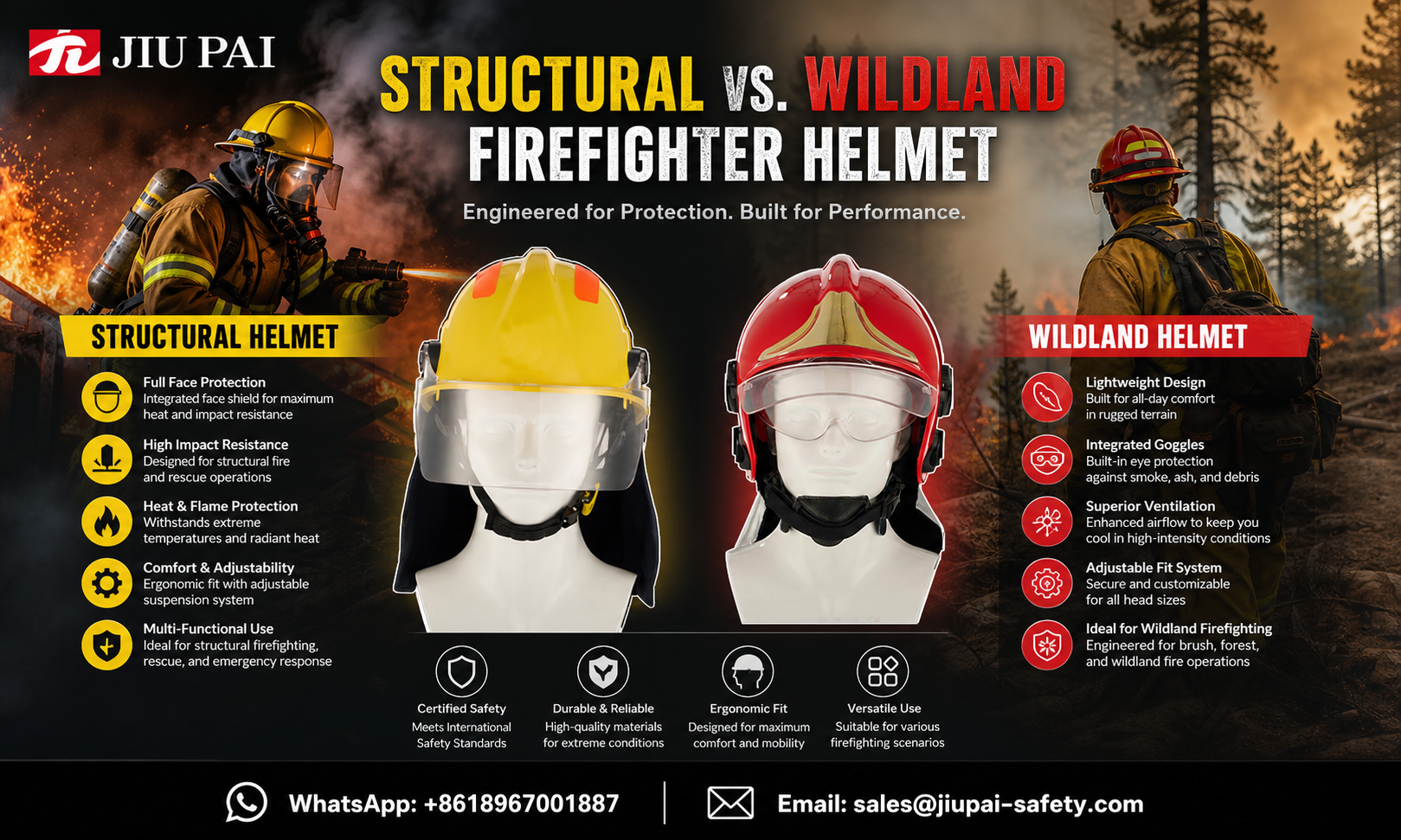
Structural firefighter helmet is made of thickened composite material and integrally molded with multi-layer thermal insulation lining, all-inclusive neck protection and protective mask. It has excellent high temperature resistance, impact resistance and penetration resistance, and can resist high-altitude hard object impact and instantaneous high temperature thermal radiation.The overall structure is compact and does not protrude, so it will not be hooked in a narrow indoor space. It can be used with all kinds of hard accessories to adapt to the complex structural fire environment in all directions.
Wildland firefighter helmet is made of lightweight and high-strength engineering plastic, with large size wide eaves and ventilation structure, which can not only block sunlight, block burning and scraping of flying stones, but also quickly dissipate heat and sweat, so as to relieve the sultry fatigue of outdoor high temperature operation.The simple streamlined shell is not easy to be hooked by branches and vines, and has high flexibility, which can effectively cope with the risk of conventional fire in the field and greatly reduce the physical consumption of long-term operation.
The working environment of wildland firefighting is open natural outdoor space with good air circulation and no risk of enclosed high temperature accumulation, but it is greatly affected by weather, terrain and vegetation.Wind force and wind direction change the direction of fire at any time. The vegetation terrain is easy to block the line of sight and hinder movement. Flying fire, embers and suspended sparks continue to exist, and the fire spreads without boundary.Environmental risks are mainly persistent and diffusive hidden dangers, including long-term sun exposure and high temperature, scraping of branches and vines, loose gravel falling, long-distance fire burning, body load caused by long-term physical labor, no risk of instantaneous structural collapse, but the overall operating environment is more complex, empty and variable.
Wildland fire protection core focuses on long-term all-weather comfort protection.There is no risk of high-intensity instantaneous explosion and collapse, and extreme airtight protection is not required. The core protection requirements are to block continuous sunlight and high temperature, burning of embers, scraping of branches and slight impact of gravel. Meanwhile, it is necessary to focus on preventing heatstroke, heat stress and physical overdraft caused by long-term operation.Protective equipment needs to give consideration to basic impact resistance, flame retardant and anti-burning performance, and at the same time ensure ventilation, lightness and flexibility, adapt to outdoor continuous operation for several hours or even a whole day, and pay more attention to long-term durability, ventilation, heat dissipation and mobility.
Wildland fire equipment overall lightweight, simple, portable strong.Considering the characteristics of long-term hiking, climbing, rapid transfer and large-scale mobility in the field, all equipment is designed with weight reduction as the core principle.The wildland firefighter helmet adopts thin high-strength shell, simple buffer structure, no redundant heavy accessories, greatly reduces the weight of the whole set of protective equipment, minimizes the physical consumption of firefighters for long-distance trekking and continuous operation, avoids physical exhaustion and slow movement caused by heavy equipment, and adapts to high-frequency movement and long-term operation scenarios.
wildland firefighting tactics are mainly divided into zones, isolated fire control, dynamic patrol and long-term clearance.There is no fixed operation point, so the team needs to adjust the operation position in real time according to the fire, wind direction and terrain, and control the large-scale fire by setting up fire isolation belt, extinguishing the fire head by sections, continuously cleaning up the residual fire and strictly preventing reignition. The operation mobility is extremely strong, requiring personnel to maneuver for a long time. The flexibility, durability and portability of equipment are much higher than the ultimate protection.
Wildland firefighter helmet adopts an open wide brim lightweight design, equipped with a wide annular brim, which can effectively block sunlight, block high-altitude flying fire, embers and falling stones, and comprehensively protect the head, forehead and neck from burning and scratching.The shell of wildland firefighter helmet adopts streamlined simple structure, no protruding redundant parts, reasonable design of ventilation holes, greatly improving air circulation and avoiding heat accumulation during long-term exposure operation.The overall structure is simple and anti-hook, it is not easy to be entangled by branches and vines when shuttling through forest shrubs and steep gullies, and it is suitable for outdoor complex terrain mobile operation. The accessories are mainly simple sunshade, dustproof and anti-splash parts, and there is no heavy supporting device.
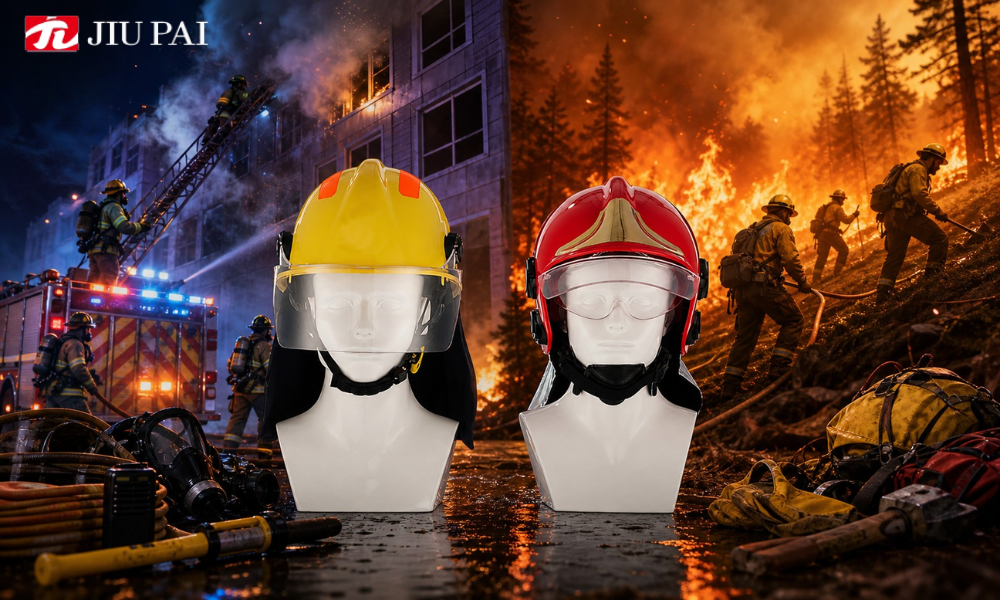
wildland firefighter helmet protection against continuous routine risks, in accordance with EN 443 specific standards.The material is mainly lightweight and high-strength engineering plastics, with excellent flame retardant, high temperature resistance and corrosion resistance. It can withstand outdoor high temperature exposure, embers burning, slight impact of gravel and branch scraping for a long time.However, its instantaneous impact resistance and high temperature resistance limit capacity are lower than that of Structural firefighter helmet, which cannot withstand heavy hard object impact, close-range open flame detonation and high-intensity thermal radiation. It is only suitable for field conventional fire protection, does not support indoor attack operation, and accurately matches continuous, low-frequency and conventional safety risks in the field.
The wildland firefighter helmet is extremely lightweight, giving priority to comfort and long-term effectiveness.By simplifying the protective structure, optimizing the material ratio and removing redundant accessories, the weight of the helmet is greatly reduced, and there is no obvious load pressure when worn.At the same time, it is equipped with breathable buffer lining, adjustable elastic buckle and ventilation and heat dissipation structure. When hiking, climbing and standing for a long time outdoors, it can effectively dissipate heat and sweat, reduce the sultry, tight and tired feeling of the head, adapt to the long-term operation demand of the whole day, and completely solve the problem of excessive physical consumption and discomfort caused by heavy fire helmet.
If it is mainly responsible for fire fighting in mountain forest, grassland and wild wasteland, opening of fire isolation belt, residual fire cleaning, outdoor fire prevention patrol, etc., lightweight wildland firefighter helmet shall be preferred. With its advantages of ventilation and heat dissipation, wide eaves protection, anti-hooking and high mobility, it shall adapt to complex outdoor terrain and long-term mobile operation, reduce physical consumption and prevent exclusive safety risks in the field.For part of the fire brigade that takes into account both types of operations, it is recommended to equip two special fire helmets, which can be switched according to the attendance scene to eliminate safety loopholes.
Wildland firefighter helmet are mainly used in natural environment fires such as forests and grasslands. They need to give consideration to protective performance and long-term operation requirements. They usually need to meet the requirements of NFPA 1977 and other relevant standards. They pass fire retardant, heat resistance, wear resistance, environmental aging resistance and other tests to adapt to high temperature, wind change and complex terrain environment in Wildland fires.
At the same time, consideration should be given to the durability of materials and environmental adaptability. Structural firefighter helmets should have high temperature resistance, aging resistance, deformation resistance and burning resistance, and can repeatedly withstand high-intensity fire environment tests. Wildland firefighter helmet should be wear-resistant, scratch resistant, ultraviolet resistant, weather resistant, suitable for outdoor long-term exposure, rain, bump loss scene.Priority is given to the selection of integrated shell and detachable replacement of accessories, which is convenient for cleaning and maintenance, replacement of accessories, extension of equipment service life and reduction of long-term procurement costs.
For fire brigades and procurement units, accurately distinguishing scenarios, strictly benchmarking standards, and scientifically selecting equipment are the keys to ensuring the life safety of front-line firefighters, improving rescue efficiency, and avoiding operational risks.Abandon the wrong cognition that equipment can be commonly mixed, match special fire helmet according to actual operation scene, give consideration to protection, comfort and durability, so that every attendance can have all-round safety guarantee, and make professional protection adapt to each fire rescue scene.
The fire conditions, fall risks and operating methods of the two fire scenarios are different, which is particularly evident in the core protective equipment fire helmet.Structural firefighter helmets focus on impact resistance and high temperature resistance, which can cope with building collapse and high temperature ignition risk. Wildland firefighter helmet are mainly lightweight, breathable and fire-proof, suitable for complex mountain terrain.This article compares the two types of fire fighting modes and special helmets in detail to help you accurately select and adapt the scene.
What Is Structural Firefighter Helmet?
Structural firefighter helmet is suitable for fire rescue in confined spaces such as buildings, workshops and tunnels. It meets the NEN 443 protection standard and is specially designed to deal with high-risk risks such as building collapse, high temperature explosion and debris puncture.This helmet is mainly used for high-intensity airtight protection, suitable for short-term high-risk operations such as indoor close-range attack, personnel search and rescue, hidden danger elimination, etc. It is the core head protective equipment for urban structural fire rescue.Structural firefighter helmet is made of thickened composite material and integrally molded with multi-layer thermal insulation lining, all-inclusive neck protection and protective mask. It has excellent high temperature resistance, impact resistance and penetration resistance, and can resist high-altitude hard object impact and instantaneous high temperature thermal radiation.The overall structure is compact and does not protrude, so it will not be hooked in a narrow indoor space. It can be used with all kinds of hard accessories to adapt to the complex structural fire environment in all directions.
What Is Wildland Firefighter Helmet?
Wildland firefighter helmet is specially designed for outdoor wildfire scenes such as mountains and grasslands. It follows EN 443 special standard and adapts to field rescue scenes with fast fire spread, complex terrain and long operation cycle.Different from heavy construction helmets, it focuses on lightweight, breathable heat dissipation, long-term comfort protection, and is suitable for long-term hiking climbing, patrol and afterfire cleaning.Wildland firefighter helmet is made of lightweight and high-strength engineering plastic, with large size wide eaves and ventilation structure, which can not only block sunlight, block burning and scraping of flying stones, but also quickly dissipate heat and sweat, so as to relieve the sultry fatigue of outdoor high temperature operation.The simple streamlined shell is not easy to be hooked by branches and vines, and has high flexibility, which can effectively cope with the risk of conventional fire in the field and greatly reduce the physical consumption of long-term operation.
Structural vs. Wildland Firefighting: Key Differences
Fire environment
The working environment of structural fire protection is closed or semi-closed artificial space, with strong closeness and poor air circulation.After the fire occurs, high temperature hot gas and toxic smoke will accumulate rapidly, indoor temperature gradient is extremely high, high temperature and high pressure environment can be formed in a short time, which is easy to trigger extreme dangerous situations such as flashover, backfire and explosion.At the same time, after the building structure is burned and damaged, hard falling objects such as walls, steel bars, glass and building materials fragments are dense, sharp penetration risk and structural collapse risk are the main environmental hidden dangers, and the overall environmental risk is concentrated, the instantaneous destructive force is large, and the danger is unpredictable.The working environment of wildland firefighting is open natural outdoor space with good air circulation and no risk of enclosed high temperature accumulation, but it is greatly affected by weather, terrain and vegetation.Wind force and wind direction change the direction of fire at any time. The vegetation terrain is easy to block the line of sight and hinder movement. Flying fire, embers and suspended sparks continue to exist, and the fire spreads without boundary.Environmental risks are mainly persistent and diffusive hidden dangers, including long-term sun exposure and high temperature, scraping of branches and vines, loose gravel falling, long-distance fire burning, body load caused by long-term physical labor, no risk of instantaneous structural collapse, but the overall operating environment is more complex, empty and variable.
Protection requirements
Structural fire protection core focuses on high intensity instantaneous safety protection.For the risk of high temperature ignition, hard object impact, debris penetration and toxic smoke attack in confined space, the complete protective equipment must have the ultimate thermal insulation, impact resistance, puncture resistance, flame retardant and airtight protection capabilities.The protection focuses on resisting instantaneous high temperature explosion, impact of falling heavy objects from high altitude and penetrating injury of sharp building materials. Meanwhile, it cooperates with a full set of respiratory protection equipment to block toxic smoke, prevent indoor high temperature burns and fatal structural collapse injuries. The protection focuses on high-intensity disaster resistance and all-round airtight protection.Wildland fire protection core focuses on long-term all-weather comfort protection.There is no risk of high-intensity instantaneous explosion and collapse, and extreme airtight protection is not required. The core protection requirements are to block continuous sunlight and high temperature, burning of embers, scraping of branches and slight impact of gravel. Meanwhile, it is necessary to focus on preventing heatstroke, heat stress and physical overdraft caused by long-term operation.Protective equipment needs to give consideration to basic impact resistance, flame retardant and anti-burning performance, and at the same time ensure ventilation, lightness and flexibility, adapt to outdoor continuous operation for several hours or even a whole day, and pay more attention to long-term durability, ventilation, heat dissipation and mobility.
Equipment weight
Structural Firefighting Equipment overall weight, heavy structure, high level of protection.In order to meet the requirements of high strength impact resistance, high temperature resistance and penetration prevention, Structural firefighter helmet, protective clothing, gloves and boots are made of thickened composite materials and multi-layer protective structure. The firefighter helmet is equipped with thickened buffer lining, solid shell, protective mask and neck protection structure. The whole set of equipment is heavy.Heavy equipment is designed to offset the extreme risks of confined spaces and adapt to short-term, high-intensity, low-frequency, hard-hitting operations without significant burden on short-term operations.Wildland fire equipment overall lightweight, simple, portable strong.Considering the characteristics of long-term hiking, climbing, rapid transfer and large-scale mobility in the field, all equipment is designed with weight reduction as the core principle.The wildland firefighter helmet adopts thin high-strength shell, simple buffer structure, no redundant heavy accessories, greatly reduces the weight of the whole set of protective equipment, minimizes the physical consumption of firefighters for long-distance trekking and continuous operation, avoids physical exhaustion and slow movement caused by heavy equipment, and adapts to high-frequency movement and long-term operation scenarios.
Firefighting tactics
Structural firefighting tactics focus on fixed-point attack, rapid disposal and accurate search and rescue.The operation team shall have clear division of labor, adopt group coordination mode, quickly break through fire scene, search and rescue trapped personnel, put out core open fire, investigate explosion hidden danger, ventilate and cool down.The core of tactics is "fast, accurate and stable", which controls indoor fire sources in a short time, prevents fire from spreading to other areas of the building, avoids structural collapse and explosion risks, fixes and concentrates the operation scope, standardizes tactical actions and processes, and has extremely high requirements on the protection stability of equipment.wildland firefighting tactics are mainly divided into zones, isolated fire control, dynamic patrol and long-term clearance.There is no fixed operation point, so the team needs to adjust the operation position in real time according to the fire, wind direction and terrain, and control the large-scale fire by setting up fire isolation belt, extinguishing the fire head by sections, continuously cleaning up the residual fire and strictly preventing reignition. The operation mobility is extremely strong, requiring personnel to maneuver for a long time. The flexibility, durability and portability of equipment are much higher than the ultimate protection.
Structural Helmet vs. Wildland Helmet: Key Differences
Helmet design
Structural firefighter helmet adopts heavy closed three-dimensional protection design, the overall structure is firm and compact, the shell thickness is higher, and it is equipped with all-inclusive neck protection, high-strength impact-proof mask and sealed buffer lining.The outline of Structural firefighter helmet fits the head without wide brim, avoiding scratch, jamming and hooking when entering the narrow indoor space, and adapting to the internal environment of the building with dense door frames, walls and pipes.At the same time, professional accessory interfaces are reserved, which can be adapted to air respirator, bright flashlight, distress device, protective mask and other complete sets of equipment. The overall design focuses on all-round airtight protection and is suitable for indoor attack operation.Wildland firefighter helmet adopts an open wide brim lightweight design, equipped with a wide annular brim, which can effectively block sunlight, block high-altitude flying fire, embers and falling stones, and comprehensively protect the head, forehead and neck from burning and scratching.The shell of wildland firefighter helmet adopts streamlined simple structure, no protruding redundant parts, reasonable design of ventilation holes, greatly improving air circulation and avoiding heat accumulation during long-term exposure operation.The overall structure is simple and anti-hook, it is not easy to be entangled by branches and vines when shuttling through forest shrubs and steep gullies, and it is suitable for outdoor complex terrain mobile operation. The accessories are mainly simple sunshade, dustproof and anti-splash parts, and there is no heavy supporting device.
Heat and impact protection
The protective performance of Structural firefighter helmets is against extreme transient risks and strictly complies with NFPA 1971 standards.The shell is made of high strength fiberglass and polycarbonate composite material, which has super impact resistance and penetration resistance, and can resist falling from high altitude, impact of hard building materials and puncture of sharp fragments.The inner layer of Structural firefighter helmet is equipped with multi-layer heat insulation buffer structure. The thickness of heat insulation layer is sufficient, which can withstand instantaneous high temperature of thousands of degrees Celsius and high-intensity thermal radiation. It can effectively isolate indoor explosion and close burning of open fire. The buffer lining can quickly absorb impact force, minimize head damage caused by collapse and falling impact, and the protection level is fully extended.wildland firefighter helmet protection against continuous routine risks, in accordance with EN 443 specific standards.The material is mainly lightweight and high-strength engineering plastics, with excellent flame retardant, high temperature resistance and corrosion resistance. It can withstand outdoor high temperature exposure, embers burning, slight impact of gravel and branch scraping for a long time.However, its instantaneous impact resistance and high temperature resistance limit capacity are lower than that of Structural firefighter helmet, which cannot withstand heavy hard object impact, close-range open flame detonation and high-intensity thermal radiation. It is only suitable for field conventional fire protection, does not support indoor attack operation, and accurately matches continuous, low-frequency and conventional safety risks in the field.
Weight and comfort
The weight of Structural firefighter helmets is high, and the protection priority is higher than lightweight.Multi-layer insulation buffer structure, thickened shell, all-inclusive neck protection, sealing accessories make the overall weight of the helmet larger, wearing a sense of obvious weight.However, due to the short duration of Structural firefighting operation, a single attack operation generally does not exceed dozens of minutes, compact operation rhythm, fixed operation range, so that the high weight will not become the core burden.The inner lining of the fire helmet is soft and fit, and the buckle is stable, focusing on ensuring the wearing stability in short-term high-intensity operation, and eliminating the potential safety hazard caused by the displacement and falling off of the firefighter helmet.The wildland firefighter helmet is extremely lightweight, giving priority to comfort and long-term effectiveness.By simplifying the protective structure, optimizing the material ratio and removing redundant accessories, the weight of the helmet is greatly reduced, and there is no obvious load pressure when worn.At the same time, it is equipped with breathable buffer lining, adjustable elastic buckle and ventilation and heat dissipation structure. When hiking, climbing and standing for a long time outdoors, it can effectively dissipate heat and sweat, reduce the sultry, tight and tired feeling of the head, adapt to the long-term operation demand of the whole day, and completely solve the problem of excessive physical consumption and discomfort caused by heavy fire helmet.
How to Choose the Right Firefighter Helmet?
Match the fire environment
The core principle of firefighter helmet selection is scene adaptation, special purpose, and cross-scene mixing is absolutely prohibited.If the core operation scenario is urban buildings, building workshops, indoor confined space fire attack, personnel search and rescue, structural danger elimination, professional Structural firefighter helmet must be selected, relying on its high strength impact resistance, high temperature resistance, airtight protection performance, resist collapse, explosion, falling object risk, ensure indoor attack safety.If it is mainly responsible for fire fighting in mountain forest, grassland and wild wasteland, opening of fire isolation belt, residual fire cleaning, outdoor fire prevention patrol, etc., lightweight wildland firefighter helmet shall be preferred. With its advantages of ventilation and heat dissipation, wide eaves protection, anti-hooking and high mobility, it shall adapt to complex outdoor terrain and long-term mobile operation, reduce physical consumption and prevent exclusive safety risks in the field.For part of the fire brigade that takes into account both types of operations, it is recommended to equip two special fire helmets, which can be switched according to the attendance scene to eliminate safety loopholes.
Check protection standards
Regular fire helmets must meet the safety certification standards for the corresponding application scenarios and target markets, which is the basis for ensuring protective performance.Structural firefighter helmets are mainly used for fire fighting and rescue operations inside buildings and need to meet strict protection requirements.Common standards in different markets include NFPA 1971 in the United States and EN 443, which is widely used in European and international markets and covers key performance tests such as impact resistance, penetration resistance, flame retardancy, high temperature resistance, thermal protection, etc. to ensure firefighters are reliably protected in high temperature, smoke and complex environments.Wildland firefighter helmet are mainly used in natural environment fires such as forests and grasslands. They need to give consideration to protective performance and long-term operation requirements. They usually need to meet the requirements of NFPA 1977 and other relevant standards. They pass fire retardant, heat resistance, wear resistance, environmental aging resistance and other tests to adapt to high temperature, wind change and complex terrain environment in Wildland fires.
Consider comfort and durability
In addition to core protective performance, wearing comfort and equipment durability directly affect rescue efficiency and long-term use costs.Focus on the lining material, suspension system and adjustment adaptability of the helmet when selecting the type. The high-quality firefighter helmet adopts moisture absorption, ventilation, soft and pressure-resistant lining material, matched with multi-dimensional adjustable suspension structure, which can adapt to different head shapes, wear stably without shaking, and work for a long time without obvious pressure feeling.At the same time, consideration should be given to the durability of materials and environmental adaptability. Structural firefighter helmets should have high temperature resistance, aging resistance, deformation resistance and burning resistance, and can repeatedly withstand high-intensity fire environment tests. Wildland firefighter helmet should be wear-resistant, scratch resistant, ultraviolet resistant, weather resistant, suitable for outdoor long-term exposure, rain, bump loss scene.Priority is given to the selection of integrated shell and detachable replacement of accessories, which is convenient for cleaning and maintenance, replacement of accessories, extension of equipment service life and reduction of long-term procurement costs.
Conclusion
Structural firefighting and wildland firefighting are two completely different rescue systems. There are essential differences from fire environment, risk hidden danger, operation tactics to equipment requirements. The corresponding fire helmet is special and irreplaceable core protective equipment.Structural firefighter helmets are mainly high-intensity, fully enclosed, anti-extreme risks, and protect indoor rescue safety. Wildland firefighter helmet is mainly lightweight, highly mobile, long-term comfortable protection, suitable for outdoor large-scale fire disposal.For fire brigades and procurement units, accurately distinguishing scenarios, strictly benchmarking standards, and scientifically selecting equipment are the keys to ensuring the life safety of front-line firefighters, improving rescue efficiency, and avoiding operational risks.Abandon the wrong cognition that equipment can be commonly mixed, match special fire helmet according to actual operation scene, give consideration to protection, comfort and durability, so that every attendance can have all-round safety guarantee, and make professional protection adapt to each fire rescue scene.
Request A Quote
Related News
Quick Consultation
We are looking forward to providing you with a very professional service. For any
further information or queries please feel free to contact us.