

How Do Reflective Strips Improve Firefighter Visibility in Low-Light Conditions?
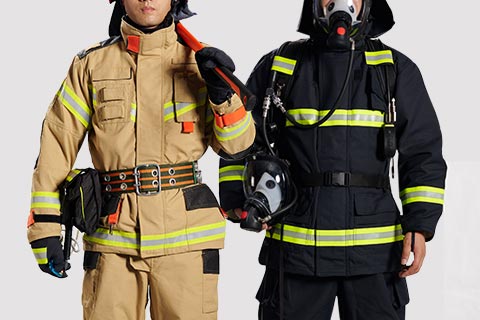
Firefighters often perform firefighting and rescue missions in environments with extremely low visibility.Fires at night, smoke-filled buildings, and underground spaces with insufficient lighting may make it difficult for people to see each other's locations clearly.The reflective strips on firefighting clothing are designed to solve such problems, and they are also one of the core configurations of high-quality firefighting clothing and firefighting protective clothing.It can reflect external light sources such as headlights and flashlights back to the observer's direction, making it easier for firefighters in fire suits to be spotted in the dark.
Why Is Firefighter Visibility Important in Low-Light Conditions?
Common low-light environments
When firefighters perform tasks, they often enter various low-light scenes. Fighting fires at night, power-off indoor fires, confined basements, and the interior of buildings obscured by thick smoke are typical low-light environments.There is often no stable lighting on the scene, the headlights and mobile lighting are easily obscured or the power is limited, the field of vision is greatly compressed, and it is difficult for the naked eye to distinguish the contours of personnel.Once the line of sight is blocked, the firefighter can easily lose his position and it is difficult to be recognized by his teammates in time.Stable visual identification is the basic guarantee for on-site operations of firefighting clothing and firefighting protective clothing.Visibility risks in smoke-filled areas
Thick smoke is the risk scene with the highest visibility of firefighters. Smoke particles will scatter and absorb light. Even if there is lighting, the beam of light will quickly attenuate, compressing the effective visual distance to within a few meters, and ordinary fabric fire suits will blend in with the gray background.It is difficult for teammates to quickly identify each other, and they are prone to accidents such as collisions and injuries from falling components.There are limitations in relying solely on auditory communication, the lack of visual identification means, and the difficulty of timely search and rescue in times of danger. The visibility of firefighting protective clothing has therefore become the core consideration in the procurement of firefighting clothing.Impact on firefighter safety
Insufficient visibility can threaten the lives of firefighters from multiple dimensions.When firefighters are trapped or injured and incapacitated, if they cannot be quickly identified, the search and rescue window will be significantly shortened.It is easy to lose contact after the personnel in the team are dispersed, increasing the probability of a single person in distress.Continuous and stable visible identification can reduce the risk of loss of contact, accidental collision, and missing search and rescue targets. It is an indispensable part of the complete firefighting personal protection system and firefighting protective clothing, which is directly related to whether the firefighting clothing can hold the safety bottom line of firefighters.How Do Reflective Strips Work on Firefighter Clothing?
The retroreflective principle
firefighting clothing reflective strips rely on the principle of reverse reflection to recover light, which is fundamentally different from specular reflection and diffuse reflection. This is the prerequisite for efficient identification of firefighting clothing and firefighting protective clothing.A large number of glass beads or prism structures are arranged inside the reflective strip. After the incident light enters the internal optical structure, it turns back in the same direction as it approaches the light source.The light source does not need to be facing the reflective strip, as long as the light falls on the surface, it can be sent back to the observer's eyes on the side of the light source.Therefore, the reflective strips of firefighting clothing do not need to emit light by themselves, and light sources such as headlights and flashlights can form eye-catching bright spots.How reflective strips return light
After the light hits the surface of the reflective strip of the firefighting suit, it first passes through the transparent protective layer and reaches the internal optical unit.The glass bead type focuses the light to the bottom reflective layer and then refracts it in reverse, while the prism type relies on the microstructure to directly fold the optical path.The foldback light is mainly oriented in the direction of the light source, and the teammates holding the lighting equipment can clearly see the bright outline of the reflective strip of the fire service uniform.Even if the angle of light is skewed, it can still produce a significant reflective effect, which allows the reflective strips of firefighting clothing to continue to play an identifying role in the rescue scene with shaking lighting and multi-angle movement.Reflective vs. fluorescent materials
The luminous mechanism of reflective materials and fluorescent materials is different, and firefighting clothing needs to be carefully distinguished when selecting materials.Fluorescent materials release visible light by absorbing the natural light of the environment. They are only suitable for dim scenes where there is still natural light. They have no effect when there is no light at all.Reflective materials are passive reverse reflection, which can be lit up when exposed to external light sources, and can be used in thick smoke and dark environments at night.firefighting clothing is often equipped with two materials. The fluorescent background color provides basic identification, and the reflective strips of firefighting clothing form a strong warning. Therefore, firefighting protective clothing adopts a combination of the two designs.What Are the Benefits of Reflective Strips on Firefighter Suits?
Improving visibility in darkness
In a fire site that is completely dark or with very weak light, ordinary firefighting fabrics are dull in color and easily blend with a dark background.The reflective strips of firefighting clothing rely on the reverse reflection characteristics. As long as the headlights and search and rescue lights are swept over, they will immediately show a high-contrast bright line outline.It does not require power supply, will not fail due to lighting equipment failure, and will not increase the weight.Even if the distance is long, the reflective outline of the fire service uniform is easier to capture, and the recognition distance can be increased several times.In non-light scenes such as power-off buildings and underground spaces, reflective strips for firefighting clothing are a low-cost and highly reliable visual solution.Identifying firefighter positions
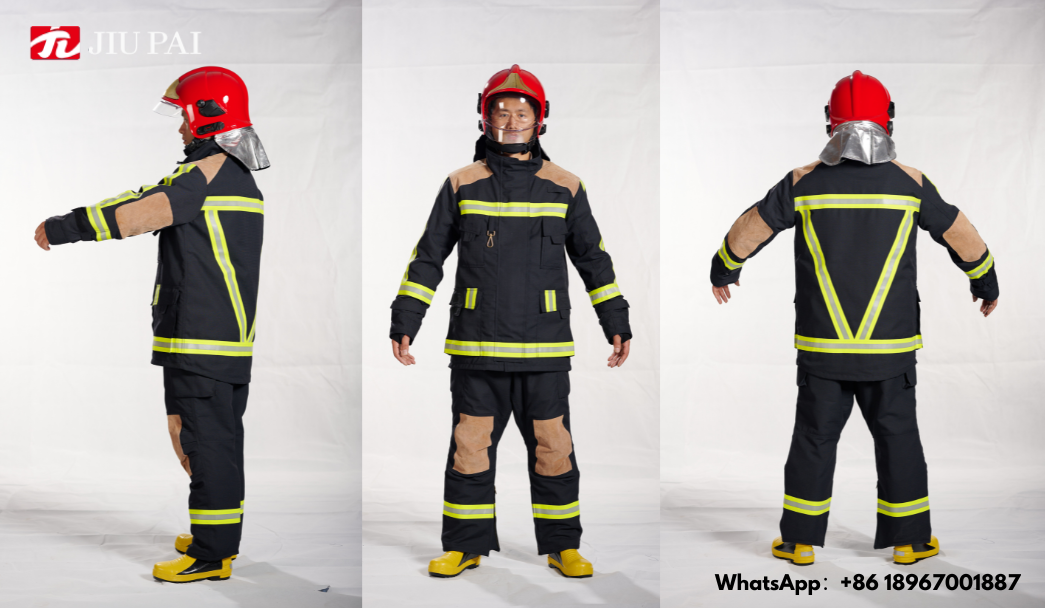
There are mixed personnel at the rescue site, including firefighters, medical personnel, engineering personnel and the affected people. It is difficult to quickly distinguish identities when the costumes are similar.The standard arrangement of firefighting clothing reflective strips will form fixed contour lines on the torso, arms, and legs. Personnel in the distance can quickly judge that this is a front-line firefighter through the reflective pattern.If a firefighter is trapped in a gap in the ruins, as long as there is light sweeping to the exposed reflective strip of the fire service uniform, the search and rescue personnel can capture the signal and quickly lock the trapped location, which fully reflects the value of the location identification of the fire service uniform.Supporting team coordination
The fire rescue team advances in coordination, and the members need to continuously grasp each other's positions and maintain a safe distance.The reflective strips of the firefighting clothing allow teammates to see the location, direction of movement and body movements of the people around them at any time. When the smoke is noisy and the walkie-talkie cannot hear the instructions, the visual signal can be used as a communication supplement.The commander can master the distribution of the team through the reflective spots on the fire service uniform, judge the pace of advancement, and avoid the team being disconnected.During emergency evacuation, high-brightness reflective signs facilitate rapid assembly, so that the synergistic value of firefighting clothing can be fully utilized.
What Types of Reflective Materials Are Used in Firefighter Suits?
Retroreflective materials
Reverse reflective materials are the core category of reflective strips for firefighting clothing, and the mainstream is divided into two categories: glass micro-bead type and micro-prism type.The reflective layer of glass microbeads has mature technology and good flexibility. It fits the fabric of firefighting clothing and has moderate cost. It is widely used in conventional firefighting and firefighting clothing. The micro-prism has a higher reflectance coefficient, stronger brightness, and better long-distance recognition, but the flexibility is weak.Both materials rely on external light sources to reflect light. During production, a protective film will be made on the surface to block water vapor and dust. It is a priority visual material designated in the fire protection clothing standards of various countries.Fluorescent materials
Fluorescent materials are generally used as the substrate or supporting logo for reflective strips of firefighting clothing. Fluorescent yellow and fluorescent orange are common, and they emit light by absorbing the ultraviolet band in natural light.In scenes where there is still natural light but insufficient brightness at dawn, dusk, rainy days, etc., fluorescent colors can form strong color contrasts, and contours can be distinguished from a long distance.However, it does not work when there is no natural light, and the recognition effect decreases rapidly after the smoke obscures the sunlight. Therefore, it is rarely used alone, and it is mostly combined with reflective strips of reverse reflective firefighting clothing to keep the firefighting protective clothing visible all day long.Heat-resistant reflective tape
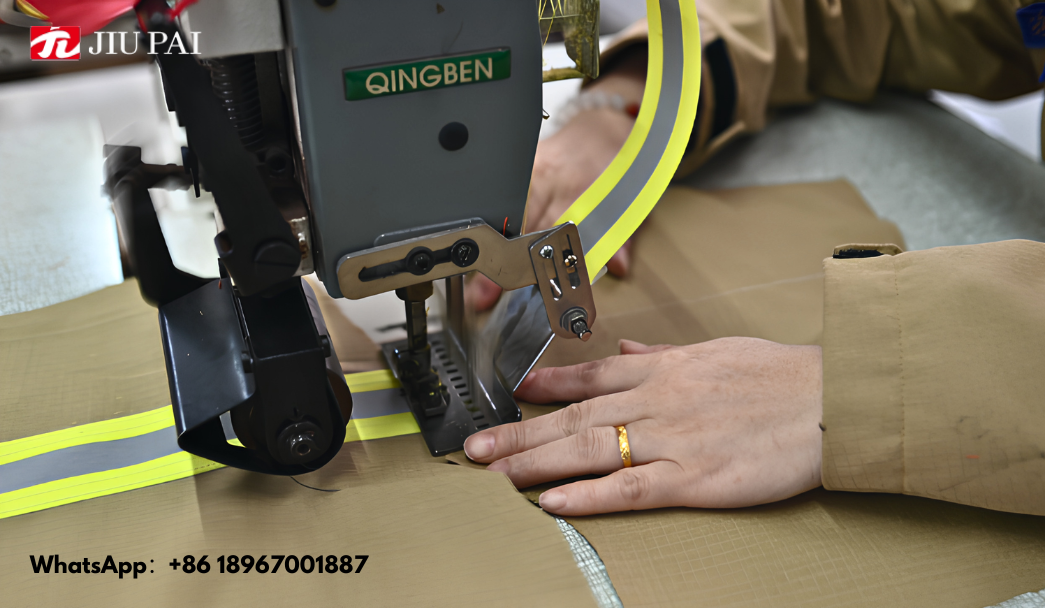
High-temperature-resistant reflective film is an upgraded reflective material for firefighting protective clothing, which is different from ordinary road reflective tape and is specially designed for firefighting clothing.Ordinary reflective strips will quickly melt and fall off in case of high temperature and open flame, and lose their reflective properties.Special heat-resistant reflective tape for firefighting clothing is equipped with aramid, flame-retardant substrate and high-temperature resistant adhesive layer. The surface coating has the ability to be flame-retardant and resistant to thermal radiation. Short-term exposure to high-temperature flames will not fail quickly. It can be directly sewn or hot pressed on the outer protective clothing of firefighting clothing.What Safety Standards Apply to Reflective Strips on Firefighter Suits?
EN 469 requirements
EN 469 is an internationally common performance standard for firefighting protective clothing, and mandatory requirements are set for the layout, material, and performance of reflective signs for firefighting clothing.The standard clarifies the arrangement position, minimum width and continuous length of the reflective strips, and requires the formation of a complete human body contour logo on the front, back, and limbs to avoid scattered reflective fragments.At the same time, it is stipulated that reflective components cannot destroy the overall flame-retardant and heat-insulating properties of firefighting clothing and protective clothing. All supporting reflective materials must be tested together with the complete set of firefighting clothing before they can be put into firefighting procurement.Reflective performance
The reflective performance index mainly refers to the inverse reflection coefficient, which represents the ability of the material to return light under a unit of light. EN 469 divides the reflective brightness requirements of fire suits of different levels.The index will distinguish the reflective performance after drying, flooding, wear and aging. The brightness of the reflective strips of firefighting clothing cannot fall precipitously after being stained with water, which can meet the use of rainy days and stagnant water fires.The standard also requires that after friction, ultraviolet exposure, and multiple cleaning, the inverse reflection coefficient should not be lower than the minimum value to ensure the long-term reliability of firefighting clothing.Heat and flame resistance
As an integral part of firefighting clothing, the reflective strips of firefighting clothing must match the flame-retardant and heat-resistant properties of the main body of the clothing.The test includes short-term flame contact and thermal radiation exposure tests, which require that the reflective layer cannot melt and drip quickly, and the drips cannot ignite the clothing.If the reflective tape of the fire service uniform is damaged in advance, the visual identification will be lost.The heat-resistant and flame-retardant index is the core dividing line between the reflective strips of firefighting clothing and civil reflective products, and it is also the focus of the production and control of firefighting clothing manufacturers, which is directly related to the protection level of firefighting protective clothing.How to Choose Firefighter Suits with High-Quality Reflective Strips?
Consider the working environment
When purchasing firefighting clothing, first select the appropriate reflective configuration based on the first-line operating environment.For conventional urban building fires, the standard EN 469 firefighting clothing reflective combination can be selected; for underground pipe corridors and confined space rescue, high-brightness prism-type firefighting clothing reflective strips are preferred; for forest fire fighting, morning and evening outdoor operations, the fluorescent substrate can be widened and the reflective structure can be matched.Scenes with high temperature and frequency must specify heat-resistant and flame-retardant reflective tape.Match the material and reflective layout according to the scene to avoid the lack of visibility of some working conditions caused by unified selection.Check reflective performance
To verify the reflective performance of firefighting clothing, you cannot only observe it with the naked eye. Priority should be given to checking the value of the inverse reflection coefficient in the third-party test report to confirm that it meets the corresponding standard level.For on-site verification, a flashlight can be used to illuminate from different angles in a dim environment to observe whether the reflection of the firefighting clothing is uniform, whether there are local dark spots and reflective breakpoints, and at the same time test the reflection changes after being stained with water.Also pay attention to the visual contour design of the reflective strips of firefighting clothing. The recognition effect of the continuous strip layout is far better than that of scattered small signs. The quality of firefighting clothing needs to be comprehensively measured.Evaluate material durability
The durability of firefighting clothing requires a comprehensive evaluation of the substrate, laminating, and bonding technology.Priority is given to the anti-friction surface coating, which is not easy to scratch or drop the film during creeping and dragging operations; the adhesive and sewing technology should be firm, and it will not rise and fall off after repeated folding and cleaning.Many low-cost firefighting clothing reflective strips have qualified brightness in the initial stage, but after several cleaning and slight friction, the reflective layer falls off and directly loses its function.Stable and long-lasting reflective performance can continuously ensure the safety of firefighters and reduce the cost of frequent replacement of firefighting protective clothing in the later stage.Balance visibility and protection
When choosing firefighting clothing, it is necessary to balance the visual effect and the protective ability of the protective clothing itself, and the reflective strips cannot be widened blindly at the expense of heat insulation and flame retardant properties.The arrangement of reflective signs cannot destroy the integrity of the flame-retardant fabric on the outer layer of the firefighting suit, and the sewing point cannot form a heat penetration channel.Under the premise of meeting the requirements of the standard reflective profile, the area of the reflective area is reasonably controlled, taking into account the recognition, flexibility and thermal protection.The high-quality solution will integrate reflective strips on top of the protective fabric to make the firefighting clothing both eye-catching and safe.Conclusion
At the fire and rescue scene, good visibility is not only related to the mutual identification of teammates, but also affects the safety of the entire rescue operation.The reflective strip of firefighting clothing passively reflects external light to provide firefighters with additional visual recognition protection, but its role is inseparable from reasonable material selection and firefighting clothing design.For fire departments and purchasing personnel, when choosing firefighting protective clothing, in addition to paying attention to the reflective effect, it is also necessary to consider whether the material can withstand high temperature, friction and repeated washing to ensure that the firefighting clothing maintains reliable performance for a long time.
Last Article:
Request A Quote
Related News
Quick Consultation
We are looking forward to providing you with a very professional service. For any
further information or queries please feel free to contact us.