

How to Choose the Right Firefighter Suit Sizes for Bulk Orders
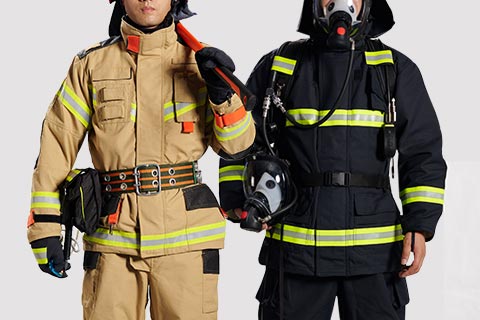
When purchasing firefighting uniforms in bulk, the choice of size not only affects the comfort and mobility of firefighters, but also the protective effect, procurement cost and order delivery.Assigning sizes based on height alone makes it easy to ignore the bust, waist circumference, inner garment thickness, and activity space during work, which leads to ill-fitting clothing and increases the pressure on rework, replacement, and inventory management.For fire departments, contractors, and fire equipment distributors, personnel measurement, size verification, and order matching planning in advance can effectively reduce these problems.Combining bulk supply and OEM and ODM customization experience, this article will introduce how to reasonably choose the size of firefighting clothing, confirm the fit of the sample clothing, and clarify the size requirements before mass production to make the procurement process smoother and allow firefighters to obtain a suitable wearing and protection experience.
Why Accurate Firefighter Suit Sizing Matters for Bulk Orders
Bulk procurement of firefighting uniforms is completely different from scattered procurement, and the losses caused by incorrect size will be magnified by the order size.Precise size solutions are not only to improve wearing comfort, but also an indispensable part of the fire protection system, which is directly related to the personal safety of firefighters, late operation and maintenance costs, and project delivery cycles.Below, the core values of accurate size are disassembled from the three dimensions of fit and mobility, protection and safety, and reduction of return and exchange waste.Improve fit and mobility
A well-fitting firefighting suit is the basis for ensuring the flexibility of firefighters' movements. Being too tight will limit rescue actions such as arm lifting, bending, crawling, and climbing. The seams of the fabric will continue to be forced and are prone to tearing.If the size is too large, the clothes pendulum and trouser legs will shake, and it is easy to be hooked by debris in the narrow fire space, interfering with the rhythm of the operation.In bulk orders, a unified and standardized size allocation allows each set of clothing to reserve a reasonable amount of activity, taking into account the fit of the package and the dynamic stretching space.In high-intensity scenes where firefighters are carrying heavy breathing apparatus and carrying demolition tools, their limbs are not bound by clothing, and their movements respond faster, greatly improving the efficiency of on-site disposal.Support firefighter safety
The flame-retardant, heat-insulating, and puncture-proof protective properties of firefighting clothing can only be fully utilized under the premise of fitting the version.Clothing that is too tight will squeeze the structure of the thermal insulation layer, destroy the air thermal insulation gap between the protective layers, and the high temperature will be more easily transmitted to the human body.Too loose will form gaps, and high-temperature smoke and molten debris will invade from the neckline, cuffs, and waist seams, causing a risk of burns.Large-scale projects are aimed at the entire firefighting team. Once the size of the batch is misaligned, the protection level of the entire team will decrease synchronously.The size scheme that strictly matches the body type can ensure that the sealing structures of the protective clothing fit normally and hold the most critical safety line of defense for front-line firefighters.Reduce returns and waste
The return and exchange process for bulk orders is complicated. Most of the firefighting protective clothing belongs to special protective products. The production cycle is long and the cost of fabrics and composite layers is high. Once the size is wrong in bulk, it will not only produce high rework and logistics costs, but also delay the on-duty replacement plan.Unsuitable clothing is difficult to deploy twice, and eventually becomes sluggish inventory, resulting in a waste of materials and funds.Invest time in the early stage to collect size data and try-on verification of sample clothes. Although a small amount of preliminary workload is added, the probability of late return and scrap can be minimized, the project budget can be stabilized, and the smooth acceptance of large-volume orders can be guaranteed. In the long run, it is the most cost-effective procurement method.How to Measure Firefighters for the Correct Suit Size
Accurate measurement is the source of size selection, and incorrect measurement methods will directly cause the entire set of size data to fail.firefighting clothing is different from ordinary tooling. The measurement needs to consider the inner wear and movement margin, and maintain a unified standard throughout the process, which is suitable for the team to collect data in batches.The following explains the main points of body measurement, the measurement requirements of inner clothing, the standardized measurement process, and the method of archiving personal data.Take body measurements
When collecting basic body data, give priority to the core dimensions of bust, waist circumference, hips, shoulder width, sleeve length, trouser length, and height. Don't just rely on a rough estimation of height and weight.It is recommended to use a professional soft ruler for measurement. Keep the soft ruler flat and close to the skin, not tight or loose, and surround the torso horizontally for readings.The bust is selected from the underarm position and the fullest part of the chest is measured horizontally.The waist circumference is in the natural waist position, avoiding the belt position.The inner length of the pants is measured vertically from the crotch point on the inner thigh to the ankle.Each data is recorded in centimeters, and special body types are marked at the same time, such as those with wide shoulders, big bellies, and thick legs, so that the size gears can be adjusted separately in the future.Measure over base layers
During firefighting and rescue operations, firefighters do not directly wear firefighting clothing naked. The inner layer usually wears close-fitting flame-retardant underwear, a warm layer, and moisture-wicking bottoming clothing. In some cold areas, the thickened warm middle layer will be superimposed.If you directly measure the net body size and choose the size according to the net size, the whole set of clothing will be significantly tight after putting on the inner layer, and there will be insufficient room for activities.Therefore, when mass-measuring, firefighters are required to wear a full set of inner-layer bottoming suits that are fixed for daily duty and then measure. The measurement value naturally includes the inner-layer thickness margin, which matches the real-life wearing scene, avoids the obvious deviation between the theoretical size and the actual wearing effect, and ensures that the size is adapted to the real combat configuration.Follow a consistent method
When multiple people work together to collect large-volume size data, inconsistent measurement standards are a high-frequency problem.Different operators have different elastic scales and measurement reference points. The deviation of the measurement data of the same person twice may reach 2 to 3 cm, and the entire batch of sizes will be distorted after accumulation.The purchaser needs to formulate a unified measurement SOP in advance, clarify the measurement starting point of each part, the elastic standard of the soft ruler, and the standing position requirements, arrange special personnel to train all measuring personnel, and uniformly use the same soft ruler to fix the measurement sequence.Priority is given to arranging fixed personnel to complete the measurement of the entire team, reducing the standard drift caused by personnel rotation, and ensuring that all data is collected under the same benchmark.Record individual measurements
For batch projects, it is recommended to establish an independent size file table to file separately for each firefighter, recording the name, position, all measurement data, body shape characteristics, and feedback on past try-on sizes, rather than simply summarizing the number of sizes.The table simultaneously marks the types of positions, such as emergency rescue, forest fire fighting, and urban waterlogging positions. The range of actions is different, and the discharge standards can be fine-tuned.Files are retained for a long time, and historical data can be directly retrieved during subsequent supplementary purchases, personnel rotation, and equipment updates to reduce duplication of quantitative work.The data files are submitted to the firefighting clothing production factory at the same time to facilitate the factory to review the coding scheme, identify data contradictions in advance, and communicate and adjust in advance.Key Factors to Consider When Ordering Multiple Firefighter Suit Sizes
Large-volume firefighting clothing orders are not simply aggregating and adding single sizes. They must also be combined with the distribution of team sizes, regional version habits, differences in body sizes between men and women, and the comprehensive planning of multi-layer protection. The size matching scheme is unreasonable, and it is easy to have a backlog in inventory of certain sizes and insufficient quantities of popular sizes.Workforce size distribution
Before counting the size of firefighting uniforms, first do distribution statistics on the measurement data of all personnel, draw the proportion of sizes, and find out the mainstream size of the team and the special size of the niche.Most fire brigade sizes show a normal distribution, with M, L, and XL as the dominant sizes, while XS, 3XL, and 4XL account for a low proportion of sizes.When matching codes, do not distribute each size evenly. Place an order according to the proportion of real personnel. The main size is purchased in sufficient quantities on demand. The niche size accurately matches the number of corresponding personnel, and a small amount is reserved for spare.At the same time, considering the flow of personnel, reserve a small amount of high-frequency size spare inventory to facilitate the replacement of newcomers and avoid temporary replenishment orders that lengthen the delivery time.Regional sizing differences
There are differences in the body shape characteristics of people in different regions. When facing overseas projects, the European standard, American standard, and national standard size systems have different benchmarks, and the design ideas of the same size ready-to-wear looseness, shoulder width, and trouser length are obviously different.European and American models generally have wider shoulders and longer torsos.The Asian version is relatively narrow.If the project is delivered to an overseas site, the experience of size distribution of the domestic team cannot be directly followed. Priority should be given to the historical data of the procurement of the same type of firefighting equipment in the local area, and try it on with local samples.Confirm the version attribution standards with the factory, adjust the size distribution ratio in advance, adapt to the body shape characteristics of personnel in the target area, and reduce the risk of size adaptation for cross-regional procurement.Gender and body shape
The body contours of men and women are significantly different, and the female size cannot be simply equated with the men's size one.The female version usually optimizes the shoulder slant, waist, and hip curve. The shoulder width is narrower and the waist-hip difference is greater. The men's version is straight and loose. Women are more likely to wear men's small size, which is prone to problems such as shoulder line slipping, waist tightness, and tight buttocks.During batch statistics, the data of men and women are archived separately, and the codes are assigned separately. Special body types such as hunchback, wide hips, and strong muscles are marked separately, and the version is adjusted in communication with the factory to ensure that people of different genders and sizes can obtain firefighting suits that take into account protection and comfort.Protective layers and clothing allowance
The number of protective layers directly determines the size of the clothing release. The structure of forest firefighting clothing, urban firefighting protective clothing, and emergency rescue clothing are different, and the inner layer configuration is different. The release standards need to be distinguished.Urban firefighting protective clothing comes with a multi-layer thermal insulation and waterproof membrane structure, and its own fabric has a large thickness after compounding, and the amount of discharge needs to be sufficient.The lightweight emergency rescue suit has a thin structure, and the release can be moderately tightened.The purchaser will sort out the thickness of the full set of equipment that is standard in the duty scene, and confirm with the factory technicians the reserved amount corresponding to each size, and take into account the bulge on the back of the respirator and the thickness of the equipment belt to prevent the clothing from tightening after wearing the full set of equipment. Stuck body.
How to Manage Size Selection for Bulk Firefighter Suit Orders
Large-volume firefighting uniform size management is a set of full-process control actions, from early data collection, size grouping, to prenatal sample confirmation, and final code matching approval, each step of closed-loop control can lock in the size risk and ensure that large-scale goods are consistent with expectations.Collect size data early
The collection of firefighting clothing size data must be placed in the early stage of the project, and the volume work should not be started until the production is scheduled.It takes cycles to collect data, review, try-on adjustment of sample clothes, and modify the matching code scheme. The hastily collected data is easy to be rough, and the lack of a try-on verification link increases the probability of errors significantly.It is recommended to start the body measurement as soon as possible after obtaining the purchase requirements, and reserve sufficient time to deal with abnormal body shape, cross-standard size, and customized version requirements, and set aside a round of sample modification cycle.Sufficient lead time also facilitates the factory to prepare the corresponding paper patterns and fabrics in advance, so as to avoid repeated changes in the size plan disrupting the production schedule and affecting the overall delivery node.Group orders by size
After collecting all valid data, group and summarize according to the size and model of the fire service uniform, generate a clear size summary list, and mark the list of personnel, number of people, and special remarks corresponding to each size.After grouping, you can visually see the number of orders for each size, quickly identify the sizes that account for abnormal proportions, and check for statistical entry errors.The list distinguishes between standard size groups and customized size groups at the same time. Standard sizes are produced according to conventional patterns, and customized sizes are listed separately, and the delivery time and cost are calculated separately.This grouping list is used as the core document for docking with the factory. The two sides check it together to reduce the poor communication information and avoid the wrong size and quantity when placing an order.Confirm pre-production samples
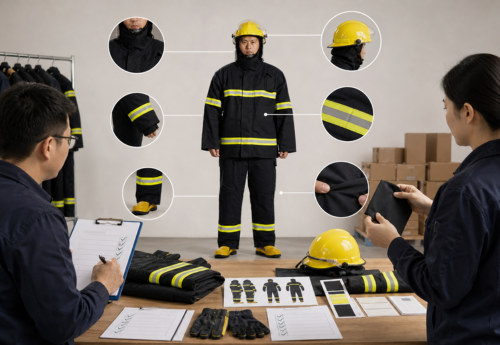
Prenatal samples are the most important verification node for batch size control. Before large-scale cutting and production, factories are required to produce mainstream firefighting clothing sizes and special-size prenatal samples in accordance with the code matching scheme.Select firefighters whose body size just falls in the upper, lower, and middle values of the size range to try on sample clothes, simulate a full set of on-site wear, and do arm lift, squatting, creeping and other movement tests to check tightness, movement margin, seam position, and pants length are up to standard.After trying it on, record the modification opinions, feedback to the factory to adjust the paper pattern, and confirm the re-proofing after the modification is completed. After the effect of all the samples is passed, mass production can be started to block the flow of size problems to large-scale goods.Approve the final size breakdown
After the firefighting clothing samples are confirmed to be correct and all the data are reviewed, a final size breakdown table will be generated, which will be jointly reviewed and signed by the person in charge of procurement, the person in charge of safety, and the person in charge of factory technology.The document fixes the order quantity, version version, release requirements, tolerance range, and sample confirmation records for each size as the basis for official production.In principle, the confirmed size plan will no longer be changed at will. Later changes will bring paper patterns and cut pieces to scrap, increasing costs and postponement risks.If follow-up personnel changes need to be fine-tuned, follow the written change process, evaluate the impact on the production progress and then implement it, leaving traces throughout the process to ensure the traceability of the project.Common Firefighter Suit Sizing Mistakes to Avoid
When purchasing firefighting suits in bulk, most of the size pits are due to several recurring common mistakes. Many buyers repeatedly step on them, causing significant losses.The following four types of high-frequency size misunderstandings are sorted out to help the procurement team avoid them in advance and establish a sense of pit avoidance.Choosing sizes by height alone
Relying only on height to choose the size of fire service uniforms is the most common and destructive mistake in bulk orders.Firefighters of the same height have great differences in weight, muscle mass, chest circumference, and waist circumference. Looking at the height and size alone, a large number of them will inevitably not fit.Many purchasing pictures are easy, and the sizes are directly divided according to the height range, ignoring the differences in circumference and body shape.Even in emergency quick code matching scenarios, height can only be used as an auxiliary reference item, and it must be cross-checked with bust and waist circumference data.Even if time is tight, priority should be given to collecting core circumference data and trying on with sample clothes to eliminate the extensive mode of determining the size of a single height, and reduce the risk of batch size failure from the source.Ignoring movement and layering
Many purchasers only consider the effect of static standing and wearing when measuring, forgetting that firefighters work dynamically in the fire field, while superimposing multiple layers of protective inner layers.He wears well-fitting clothing, puts on the heat-insulating inner layer, and puts on the air respirator on his back, immediately tightens, raises his hands and bends over to be restricted.The size selection of firefighting clothing cannot be based on static fit as the standard, but on dynamic operation and the adaptation effect of a full set of wear conditions as the judgment standard.The process of trying on the sample clothes must simulate the real on-duty wear configuration, complete a full set of motion tests, and confirm that the margin is sufficient. You can't just stand and observe the tightness of the appearance, otherwise the sample clothes are qualified and cannot be used normally in actual combat scenarios.Using inconsistent measurements
Decentralized quantities, multi-person operation, and no unified SOP bring confusion in measurement standards, which are invisible risk points.The different tightness of the soft ruler and the different definition of the measurement reference point will make the entire database lose its reference value, and the subsequent codes will all be based on the wrong data.The team must fix the measurement process, uniformly train the measuring personnel, conduct regular spot checks and retests, randomly select personnel to check the data twice, and investigate records with excessive deviations.After the data is entered, set up verification rules to identify abnormal data that clearly conflict between height and circumference, and return it for re-measurement to ensure the stability and reliability of the entire batch of fire service size data sets.Ordering without fit testing
It is the most risky operation to skip the try-on link and place a large order directly.No matter how perfect the paper data is, it cannot completely replace the feedback of real people trying on it. The thickness changes after the pattern and fabric are combined will bring a different wearing experience from the theoretical calculation.Even if the project construction period is tight, at least take a sample of the typical personnel of each size before the trial, and record the wearing feedback.The try-on is not just to see if it is comfortable or uncomfortable. It focuses on evaluating the protective sealing, activity margin, and equipment superposition adaptability. The try-on record is retained as the acceptance data. The confirmation of the try-on has not been completed, and mass production is resolutely not started to avoid the risk of large-scale orders being scrapped.Custom Firefighter Suit Sizing for OEM and ODM Orders
OEM and ODM customized firefighting clothing items, with higher freedom in the size system, are not limited to the manufacturer's ready-made standard size table, and are suitable for customers with exclusive version specifications, special users, and overseas own brands.Customized sizes have higher requirements for document specifications, pattern grading, and sample verification, and require factories and customers to work together to lock in a complete set of size rules.Customize size specifications
OEM and ODM projects can customize a full set of firefighting clothing size specifications from scratch according to the target customer group type, and independently define the bust, waist circumference, length of clothes, inner length of pants, shoulder width and other dimensions of each size, and set the size difference.Customers can design their own size matrix based on their own market user data, such as adding more lengthened pants and widening waist sizes to suit specific groups of people.JIUPAI firefighting clothing manufacturers can issue a complete customized size specification book in accordance with customer needs, distinguish between men's and WOMEN's version parameters, clarify the discharge standards corresponding to different protection levels, and fully integrate customers' protection STANDARDS and version PREFERENCES into the size parameters to form A size system that belongs exclusively to the BRAND.Confirm grading rules
The grading rules are the core of custom firefighting clothing styles, defining the difference between the increase or decrease of each part of the adjacent size, such as how many centimeters the bust increases by each size, the sleeve length, and the pants length increase synchronously.The grading rules determine whether the gradient of the entire set of sizes is uniform, so as to avoid the situation where the gap between adjacent sizes is increasing or decreasing, and some sizes are worn incorrectly.In the early stage of the ODM project, the two parties must confirm the classification rules one by one, and lock the differences in all parts of the shoulders, chest, waist, sleeve length, and trousers length in writing. The factory develops a full set of paper patterns in accordance with the confirmed classification rules.The graded documents are archived synchronously, and the same set of rules is used when subsequent orders are turned over and sizes are added to ensure the consistency of sizes across batches.Test fit samples
There is no ready-made reference experience in custom-made firefighting clothing sizes, and the verification link of sample clothing is more critical than the standard order.The factory produces the first version of the sample clothes in accordance with the customized parameters and grading rules, arranges testers of different body types to try them on, and evaluates whether the size gradient is smooth, whether the version meets the design expectations, and whether there is any imbalance in the version of a certain size. Problem.After trying on the firefighting suit and collecting feedback, adjust the pattern parameters and grading rules, and iterate over the sample clothes until the full-size gradient wearing effect is stable.All size samples are confirmed and sealed, and samples are kept as a comparison benchmark for subsequent large-scale production and quality inspection, to ensure that the size of each subsequent batch of orders is stable and uniform.Document approved measurements
All customized size parameters, grading rules, and version modification records that have been tried on and confirmed shall be summarized into formal size technical documents, which shall be signed and archived by both parties as permanent technical standards for OEM/ODM projects.The file contains the size of the full set of parts of each size, the tolerance range, the release description, the sample number of the sample clothes, and the try-on report.Subsequent return orders, production, and quality inspection are all based on this document as the only basis, and the fire service uniform version will not be out of shape due to the change of production team or order batch.A perfect size document system also facilitates customers to connect with downstream distributors and terminal units, and outputs a unified size purchase guide to enable long-term market operations of customer brands.Conclusion
Choosing the right size of firefighting clothing has never been a simple part of the procurement process, but the basic work of ensuring protective performance and ensuring the safety of front-line firefighters.The size control of bulk orders needs to run from the early data collection, interpretation of the size table, and trial-on of the sample clothes to the final code confirmation. It cannot be roughly estimated based on experience alone.JIUPAI firefighting clothing manufacturer, relying on mature measurement standards and version development capabilities, can not only supply stably according to standard sizes, but also undertake OEM and ODM customized size development.Rigorous size management can help customers avoid return and exchange losses, so that every set of firefighting clothing delivered can achieve a balance between protective fit and flexible movement.
Next Article:
Last Article:
Request A Quote
Related News

Quick Consultation
We are looking forward to providing you with a very professional service. For any
further information or queries please feel free to contact us.