
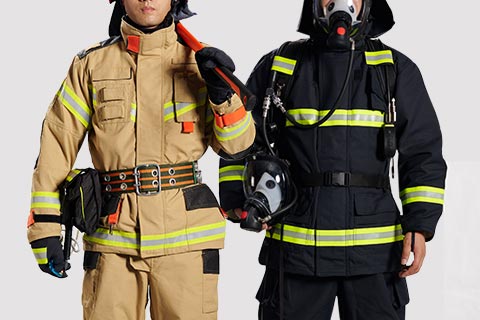

Fire Proximity Suits: Ensuring Worker Safety in Extreme Environments
In extreme high temperature operation scenarios such as airport fire fighting, oil and gas exploitation, iron and steel smelting, chemical production, etc., conventional fire fighting clothing cannot resist high-intensity radiant heat, molten metal splash and continuous high temperature attack, which is easy to cause safety accidents such as scald, burn and heat exhaustion of operators.Fire Proximity Suit is a special protective equipment specially developed for extreme high temperature and near fire operation. With professional heat insulation and flame retardant, anti-sputtering and high mobility characteristics, it becomes the core safety barrier for workers under high risk and high temperature conditions.This article will completely dismantle the close insulation protective clothing, help enterprises to purchase accurately, and maximize the safety of front-line operators.
NFPA 1976 (American Standard): Specific standard for high temperature and near fire protection equipment, rigorous assessment of radiant heat protection, high temperature resistance performance, mainstream certification of high-end industrial fire protection equipment.
ISO 11612 (international): general test standard for fire retardant protection, verifying the basic performance of fire retardant, heat insulation and anti-sputtering of products.
JIUPAI Safety is deeply engaged in the field of special protective equipment. With mature technology, strict quality control and customized services, we provide professional protective solutions with high adaptability, high durability and high safety for major high-risk industries, so that every high temperature operation is more secure, compliant and secure.
What Is a Fire Proximity Suit?
Definition
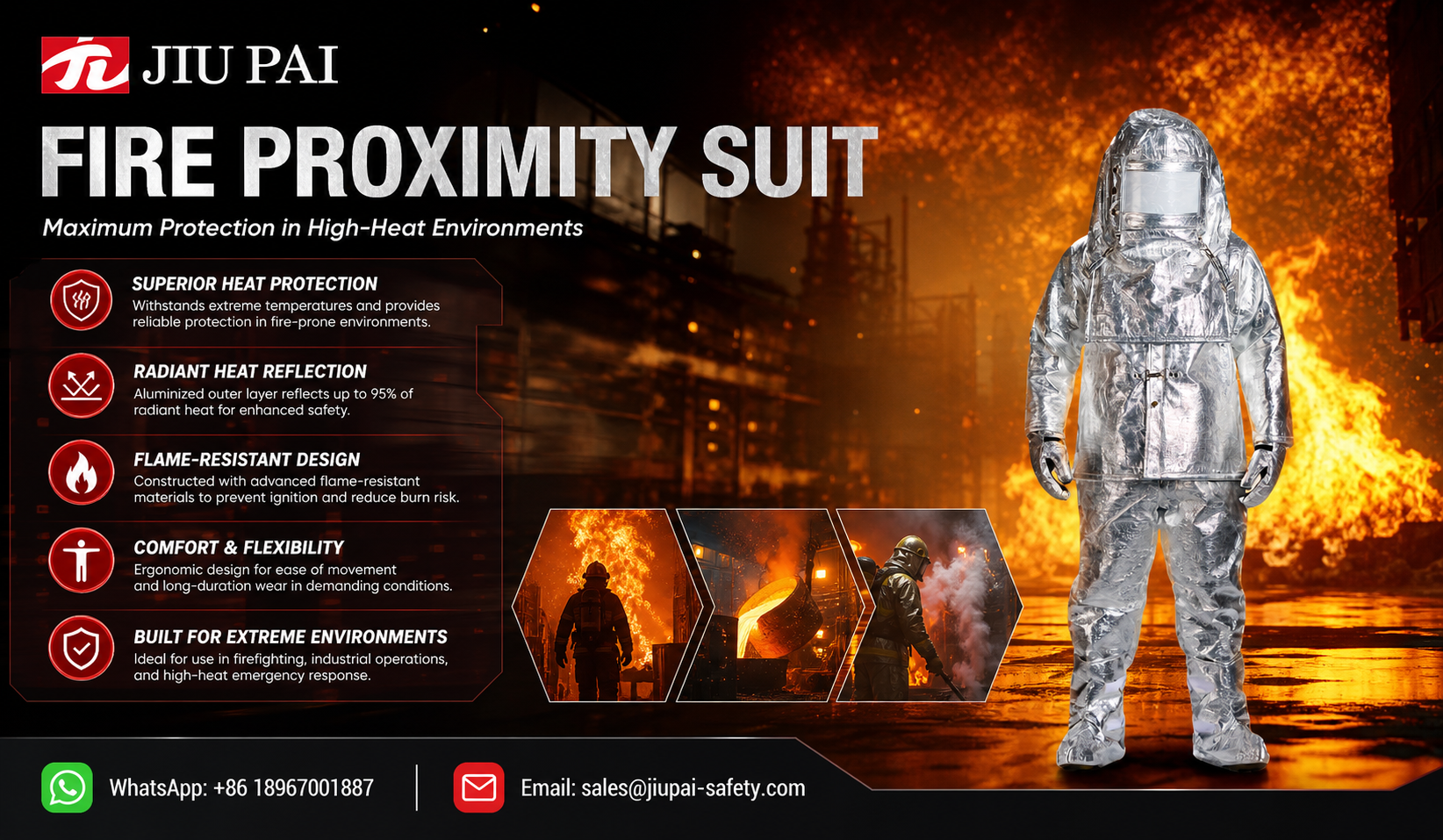
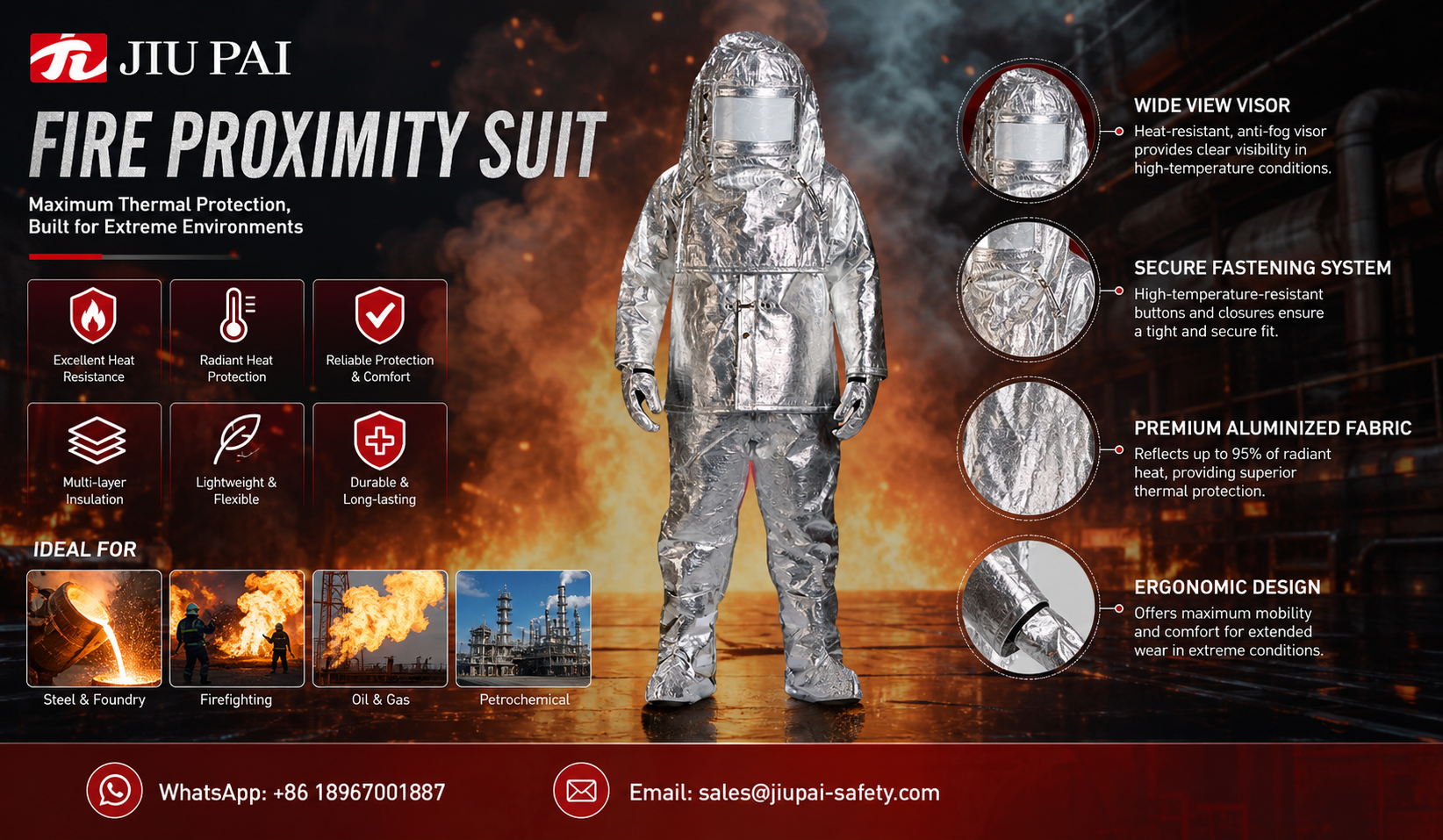
Close insulation suit is a special flame-retardant heat insulation suit with multi-layer composite structure. Its core function is to provide close high-temperature environment protection for operators. It is suitable for operation scenes close to open fire, high-temperature equipment and molten materials. Aluminized fire proximity suit adopts aluminized reflective fabric and multi-layer heat insulation flame-retardant structure, which can efficiently reflect radiant heat, block heat conduction, resist flame burning and molten metal sputtering. Different from ordinary fire suit, it mainly focuses on long-term near-high temperature. Safety protection for non-direct fire, widely suitable for industrial high temperature operation and maintenance, special fire protection, metallurgical processing and other subdivision scenarios.
How it differs from ordinary firefighting clothing
Many purchasers are easy to confuse the three types of protective equipment: structural fire suit, close insulation suit and fire entry suit. The protection level, applicable scene and material performance of the three types are very different. The wrong selection will directly lead to protection failure.The following is a comprehensive comparison of the three types of fire-fighting clothing, clearly distinguishing the core differences:| Equipment Type | Core Positioning | Protection Performance | Typical Applications | Core Limitations |
| Structural Firefighting Suit | Conventional building fire rescue | Basic flame retardancy and convective heat resistance, no strong radiant heat protection | Civil building fire suppression and routine firefighting operations | Cannot withstand high-intensity radiant heat; prone to failure in high-temperature and splash environments |
| Fire Proximity Suit | Industrial near-fire and high-temperature protection | Powerful radiant heat reflection, multi-layer thermal insulation, flame resistance and molten metal splash resistance | High-temperature operations in airports, oil & gas, metallurgy, glass manufacturing and LNG facilities | Not applicable for entering enclosed core open fire zones |
| Fire Entry Suit | Extreme fire in-depth rescue | Full-range high temperature and flame resistance with supreme thermal insulation performance | Enclosed fire entry and extreme open fire emergency rescue | Bulky and inflexible with high cost, unsuitable for daily inspection work |
How Does a Fire Proximity Suit Protect Workers?
Fire proximity suit is not a single flame retardant fabric protection, but through the five core mechanisms of heat reflection, heat barrier, flame retardant, anti-sputtering and high mobility adaptation, it builds a high temperature safety barrier layer by layer to adapt to various extreme high temperature conditions.Its protection logic conforms to the three physical principles of heat conduction, heat radiation and heat convection, blocking high temperature damage from the source.Reflecting radiant heat
Certified fire proximity suit outer layer adopts exclusive aluminized reflective fabric, silver metal coating can efficiently reflect more than 90% of infrared radiation heat, blocking radiation heat emitted by high temperature equipment, open fire and molten materials from attaching to human body.Different from the passive heat insulation of ordinary fabrics, the structure is active heat dissipation reflection, which greatly reduces the heat absorption of the human body and is suitable for long-term and short-distance high temperature operation.Multi-layer thermal insulation
A multilayer composite structure of a reflective outer layer, a flame retardant heat insulation middle layer and a breathable comfortable inner layer is adopted, and each layer performs its own duties.The outer layer reflects heat, the middle layer of high-density flame-retardant insulation cotton can greatly reduce the heat conduction rate, block heat from penetrating the fabric and contacting the skin, and the inner layer of breathable skin-friendly material reduces the sultry feeling.Through layers of barriers, effectively delay high temperature penetration, avoid surface burns and body heat accumulation of operators.Flame resistance
Fire proximity suit overall fabric uses aramid flame retardant substrate, with flame retardant impregnation process, with permanent flame retardant characteristics, in case of open fire does not burn, does not drip, does not melt carbonization.It can resist short-term flame sweep and close baking of open fire, eliminate secondary damage caused by fabric ignition, and fully adapt to all kinds of high temperature operation scenarios with open fire hidden danger.Molten metal splash protection
Exclusive compact composite structure and high temperature resistant coating can effectively resist splashing of molten steel, molten iron, molten aluminum, molten glass and other high temperature materials.Splashing molten materials will quickly slide down after contacting the fabric, without adhesion, to avoid deep burns caused by high temperature melt adhesion, which is the core protection function of metallurgy, casting and glass processing industries.Maintaining mobility in high-heat areas
Compared to heavy fire entry suits, close body protective suits are ergonomically optimized to retain extreme protection while balancing limb flexibility.The joint parts adopt elastic splicing design, and the lightweight layered structure does not restrict the flexion and extension of arms and legs, ensuring that operators can operate flexibly during high-temperature equipment maintenance, emergency response, and material handling, and avoid operation errors caused by heavy protective equipment.Industries That Require Fire Proximity Suits
Different from the general attributes of general fire fighting clothing, close thermal insulation protective clothing is the special protective equipment just needed by many high-risk and high-temperature industries, and it is also the core requirement of industry safety production compliance.Airport firefighting
Airport aircraft fire, fuel leakage burning scene, there are high-intensity fuel open fire, continuous radiant heat and high temperature smoke, conventional fire clothing can not resist close range high temperature baking.Close insulation protective clothing can support firefighters to deal with aircraft fires at close range, clean up fuel high temperature hazards, resist strong radiant heat and sputtering high temperature materials generated by aviation fuel combustion, and ensure the safety of airport emergency fire fighting operations.Oil and gas
In the operation of oil fields and offshore drilling platforms, oil and gas leakage and explosion, high temperature overheating of equipment, and high temperature operation and maintenance of pipelines are high-frequency risk scenarios.Operators shall inspect high temperature pipelines at close range, handle small fires and overhaul high temperature equipment. Close thermal insulation protective clothing can effectively block the radiant heat of oil and gas combustion, prevent sudden high temperature burns, and adapt to extreme high temperature operation environment in the field and at sea.Petrochemical plants
In petrochemical production process, reactor, distillation tower and high temperature pipeline are in high temperature operation state for a long time, which has the risk of material leakage combustion, high temperature thermal radiation and chemical high temperature sputtering.Workshop operation and maintenance, equipment maintenance and emergency inspection personnel must wear close thermal insulation protective clothing to resist continuous high temperature radiation and short-term open fire risks and avoid industrial high temperature safety accidents.Steel mills
Steel smelting, steel rolling and steelmaking workshops operate in ultra-high temperature environment. The environmental temperature of the workshop remains high for a long time, and there are multiple risks such as molten steel splash, high temperature billet radiation heat, high temperature baking of equipment, etc.When operators operate steelmaking equipment, transfer billets and clean slag in close proximity, they need to rely on close thermal insulation protective clothing to resist high-intensity radiant heat and molten steel sputtering damage.Foundries
Casting industry molten metal pouring, casting molding, furnace operation and maintenance links, high frequency face molten iron, alloy melt splash, furnace mouth continues to emit super radiant heat.When operators finish pouring, demoulding and equipment maintenance at close range, close thermal insulation protective clothing can effectively prevent sputtering, high temperature insulation, and avoid molten material burns and long-term high temperature damage.Glass manufacturing
The operating temperature of glass melting furnace is as high as 1500 ℃ or above, and the furnace body and discharge port continuously emit extremely strong radiant heat. There is a risk of splashing molten glass during operation.Batching, discharging, furnace body inspection, equipment maintenance personnel, need to wear professional close thermal insulation protective clothing, long-term close range high temperature baking, resist molten glass sputtering damage.Aluminum processing
In aluminum electrolysis, aluminum smelting, and aluminum hot rolling workshops, the melting temperature of molten aluminum exceeds 600 ° C, and the operating environment is high temperature and heat, accompanied by risks such as aluminum water splashing, high temperature flue gas, and equipment heat radiation.Close insulation protective clothing can adapt to continuous high temperature operation scenarios in aluminum processing industry, effectively block radiant heat, prevent molten aluminum water sputtering, and adapt to normal high temperature operation and maintenance operations in workshops.LNG facilities
During the operation and maintenance of LNG storage tank, gasification station and transmission pipeline, although the medium is low temperature, high-intensity high-temperature open flame and radiant heat will be generated after leakage combustion. Emergency disposal and equipment maintenance shall be close to the high-temperature combustion area.The close insulation protective clothing can resist the strong thermal radiation and flame baking generated by LNG combustion, and ensure the safety of emergency rescue and hidden danger investigation operators.
Common Workplace Hazards Against Which Fire Proximity Suits Protect
In the process of enterprise selection and use, it is necessary to clearly distinguish the equipment protection boundary to avoid potential safety hazards caused by excessive dependence or wrong use.The following defines the core protection risks and protection blind areas.Radiant heat
- Radiation heat: fire proximity suit can resist high intensity, long-term infrared radiation heat, adapt to all kinds of high temperature equipment, open fire, molten materials generated by thermal radiation damage.
- Convection heat: block high temperature hot air flow, hot air baking, avoid body surface convection heat burns
- Flashing flame: can resist short-term flashing, flame sweep, close range open fire baking
- Molten metal splash: effectively protect molten steel, aluminum, glass melt, alloy melt and other high temperature molten materials splash scald
- High ambient temperature: suitable for continuous high temperature operation in high temperature workshop and near fire area, relieve heat accumulation and thermal fatigue of human body.
Convective heat
Unable to withstand continuous closed flame immersion, do not directly rush into high-intensity open fire core fire.No professional explosion-proof, anti-chemical corrosion function, can not protect strong acid alkali, toxic chemical liquid corrosion.No high voltage protection ability, unable to withstand high voltage shock, explosion shock wave.It is impossible to completely isolate high temperature smoke and toxic gases. Closed toxic environment must be used with SCBA breathing equipment.Fire Proximity Suit vs Fire Entry Suit
The two high temperature protective equipment are easy to be confused, and they are also high-frequency search and comparison keywords in the industry. The following seven core dimensions are accurately compared to clearly adapt to different operation scenarios, providing accurate basis for enterprise procurement.| Comparison Dimension | Fire Proximity Suit | Fire Entry Suit |
| Protection Level | Secondary high-temperature protection, focusing on near-fire radiant heat and splash resistance | Highest-level full protection with comprehensive flame and high-temperature resistance |
| Working Distance | Near-fire operation within 0.5–3 meters, no direct contact with core open fire zones | Allows entry into core fire zones for short-duration flame immersion operations |
| Heat Resistance | Long-term resistance to 300–500℃ radiant heat; short-term tolerance up to 600℃ | Short-term resistance to extreme 800–1000℃ open flames with continuous flame-burning endurance |
| Typical Applications | Industrial high-temperature inspection, metallurgy, foundry, airport near-fire response, oil & gas equipment maintenance | Confined space fire rescue, extreme fire emergency response, in-depth fire suppression operations |
| Core Materials | Aluminized reflective fabric, aramid base material, multi-layer lightweight thermal insulation cotton | Reinforced aramid/PBI high-grade flame-retardant material, multi-layer high-density insulation and flame-proof compact layer |
| Weight | Lightweight structure with high flexibility for daily field operations | Heavy multi-layer structure with heavier weight and limited body mobility |
| Cost | Cost-effective, suitable for regular bulk procurement and daily industrial use | High manufacturing cost, only for extreme emergency rescue rather than daily work |
Key Materials Used in Fire Proximity Suits
The ultimate protection performance of the equipment, the core relies on the composite collocation of four high-end special materials, each material has its own duties, forming a complete protection system of reflection, flame retardant, heat insulation and wear resistance.Aluminized fabric
As the core protective material of the outer layer, a dense metal aluminum layer is attached to the surface of the high-performance substrate by vacuum aluminizing process. The core principle of the silver aluminum layer is mirror reflection, which can reflect most of the infrared radiation heat like a mirror and reduce heat absorption.This material does not store heat, does not absorb heat, can quickly dissipate surface waste heat in high temperature environment, is the core material to resist radiant heat.Aramid fiber
High-end aramid flame retardant fiber (Nomex/Kevlar), with permanent flame retardant, high temperature resistance, tear resistance, high strength characteristics.No melting, no dripping, no carbonization fracture under extreme temperature, excellent mechanical properties, wear resistance, can adapt to complex industrial operation scenarios, long-term use is not easy to damage, to ensure the structural stability of equipment.Flame-resistant insulation
The middle layer adopts high-density flame-retardant insulation cotton, and the pore structure can lock air and form a static insulation layer, which greatly reduces the heat conduction speed.Effectively block the outer layer of high temperature penetration to the inner skin, while having ventilation performance, reduce the operator sultry heat accumulation, balance protection and comfort.Heat-reflective outer layer
The outer layer of fire proximity suit is compounded with heat resistant coating to strengthen the adhesion of aluminum layer and prevent aluminum layer from falling off and failure after long-term high temperature use.At the same time, it improves the sputtering resistance, aging resistance and oxidation resistance of the fabric, adapts to long-term high temperature, dust and complex working conditions, and prolongs the service life of the equipment.What Standards Should Fire Proximity Suits Meet?
Compliance certification is the core guarantee of equipment protection performance. Protective clothing without formal certification has serious potential safety hazards.Formal products should meet the following international and domestic authoritative standards, which can be verified item by item when purchasing.Core performance standards
EN 1486 (European Union standard): international close body heat insulation protective clothing core authority standard, standardize product heat resistance, flame retardant, anti-sputtering, mechanical properties, is the export and foreign trade enterprises necessary certification.NFPA 1976 (American Standard): Specific standard for high temperature and near fire protection equipment, rigorous assessment of radiant heat protection, high temperature resistance performance, mainstream certification of high-end industrial fire protection equipment.
ISO 11612 (international): general test standard for fire retardant protection, verifying the basic performance of fire retardant, heat insulation and anti-sputtering of products.
Procurement certification verification method
When purchasing, it is necessary to ask the manufacturer for the third-party authoritative test report and product certification certificate, and check that the certificate model is consistent with the actual product.Check the heat-resistant temperature, thermal protection time, flame retardant grade and sputtering protection parameters in the report, and eliminate OEM and false certification products.Priority shall be given to regular manufacturers with complete qualifications and certificate traceability inquiry to avoid compliance risks.How to Choose the Right Fire Proximity Suit
The high temperature risks of different industries and different working conditions are very different, and blind procurement of general funds will lead to insufficient protection or excessive procurement.The following standardized procurement process helps enterprises accurately select, reduce costs and increase efficiency, and ensure safety.Working temperature
Before purchasing close thermal insulation protective clothing, enterprises need to accurately survey the normal temperature and instantaneous peak high temperature of the operation area to match the protective equipment corresponding to the heat resistance grade.Under normal mild and high temperature conditions within 300 ° C, standard basic style can be selected to meet daily protection.In the face of extreme conditions of high-intensity radiant heat above 500℃ and frequent open flames, thickened and strengthened versions must be selected.Strictly put an end to the replacement use of low-level equipment, and avoid potential safety hazards such as protection failure and personnel high temperature burns from the root cause.Exposure time
The procurement and selection shall be strictly distinguished from the operation mode, and the equipment shall be selected according to the exposure time of personnel to high temperature.For short-term emergency operations such as sudden fire disposal and temporary equipment repair, lightweight basic style protective clothing is sufficient to meet the protection requirements, flexible, convenient and cost-effective.For long-term operation scenarios such as normal inspection of workshop and all-day high temperature duty, high heat insulation and anti-fatigue upgrade shall be selected to effectively resist continuous high temperature erosion and avoid equipment performance attenuation, personnel accumulated heat damage and thermal fatigue problems.Industry
The risk of high temperature operation in different industries is significantly different, so it is necessary to accurately select the hidden danger in combination with the scene.Metallurgy, casting industry focus on preventing molten metal splash damage, need to focus on anti-sputtering strengthened version.The airport fire scene needs to adapt to the intense radiant heat and open fire generated by fuel combustion.Chemical and LNG facilities focus on emergency adaptability and temperature stability.Targeted matching of exclusive protective equipment can maximize the requirements of fitting conditions, ensure operation safety and avoid protection loopholes.Mobility
The operation attribute of the work post is an important basis for the selection of the type, and it is necessary to balance the protection performance and the operation mobility.For fine operation posts such as fine maintenance of equipment, tool operation and point debugging, lightweight, highly elastic and optimized protective clothing for joint parts shall be preferred to ensure flexible flexion and extension of limbs.For fixed point duty, close-range fire disposal and high-intensity and high-temperature emergency rescue posts, thickened and high-protection versions can be selected to comprehensively improve the safety protection capability under extreme environments without affecting basic operations.Certification
Qualification certification is the core certificate of protective performance and compliance of protective clothing, which must be strictly checked when purchasing.Domestic operations shall comply with GA fire protection industry standards and ISO general flame retardant protection specifications to ensure safety production compliance in the factory area.Export foreign trade orders must strictly match EN 1486, NFPA 1976 and other international authoritative certification.Be sure to verify that the certificate and test report are consistent with the product model, eliminate the labeled unqualified products, and ensure that the equipment is legal, compliant and up to standard.Size
Size fit directly determines the protection effect and wearing comfort, which is a key detail in the selection.Too large a size will cause loose wear, too large gaps in clothing, resulting in high temperature airflow and molten debris infiltration, causing safety hazards.Size too small tight binding limbs, accelerate high temperature fatigue, affect the operation efficiency.It is necessary to standardize the selection according to the height and body shape of the staff. The special size can be customized for special body shape to ensure that the wear fits tightly and the protection has no dead angle.Accessories
A complete protective system cannot be separated from supporting accessories, and a single protective clothing cannot achieve all-round protection.According to the actual operation scenario, the enterprise shall be equipped with suitable thermal insulation hood, flame retardant protective gloves, high temperature resistant protective boots, special storage bag and respiratory equipment adapter accessories.The complete set of equipment can be seamlessly connected and closely matched, which can completely eliminate protection blind areas, avoid local exposure risks, and construct a full-dimensional high temperature safety protection barrier from head to toe.Manufacturer experience
High quality close insulation manufacturer is the core support of product quality and after-sales guarantee.The procurement shall give priority to the source manufacturers with independent R & D and production capacity in the field of fire protection. Such manufacturers have mature processes, strict quality control and stable and durable product performance.JIUPAI has multi-industry customization experience, can provide professional selection guidance, effectively avoid procurement pit, reduce equipment use and replacement costs, and ensure long-term operation safety.FAQ
Can a Fire Proximity Suit withstand direct flames?
It can withstand short-term flame sweep and close-range open fire baking, but it does not support long-term and continuous open fire immersion. It cannot be directly rushed into the closed core fire field. It is only suitable for near-fire and high-temperature operation. Professional fire entry clothing is required for deep fire rescue.What is the difference between aluminized and non-aluminized fire suits?
Aluminized outer layer with mirror reflective coating, mainly radiation heat protection, suitable for high temperature radiation, melting sputtering scene.The non-aluminized version only has basic flame retardant function, no radiant heat reflection ability, only suitable for ordinary open fire scenes, unable to adapt to industrial extreme high temperature conditions.Are fire proximity suits waterproof?
Conventional models have slight splash resistance, can resist rain, water stains splash, but no professional waterproof, impervious liquid function, can not be immersed in water for a long time, can not protect chemical liquid leakage, wet environment after use in time to dry maintenance.How often should fire proximity suits be inspected?
Daily use requires pre-job inspection before each wear.The enterprise carries out a comprehensive special inspection once a month.A third-party professional performance test is conducted once a year to investigate hidden dangers of protective performance degradation.Can they be customized?
It supports full-dimensional customization. It can customize size, version, enterprise LOGO and color matching according to enterprise needs. At the same time, it can strengthen local protection and adapt exclusive accessories for special working conditions to meet the personalized use and brand management needs of enterprises.Can fire proximity suits be worn in winter?
Fully adapted, equipped with multi-layer insulation structure can block the external high temperature, at the same time has a certain degree of warmth, winter high temperature workshop, outdoor near fire operation can be worn normally, will not appear too cold, overheating discomfort problems.Conclusion
In airport, oil and gas, petrochemical, metallurgy and other high-risk and extreme high temperature industries, close thermal insulation protective clothing is the core special equipment to protect the life safety of front-line operators, ensure the safety production compliance of enterprises and avoid the risk of safety accidents.Different from ordinary fire-fighting clothing, its exclusive radiation heat reflection, multi-layer heat insulation, anti-melting sputtering, high mobility, accurately solve the core protection pain point of industrial near-fire high temperature operation.JIUPAI Safety is deeply engaged in the field of special protective equipment. With mature technology, strict quality control and customized services, we provide professional protective solutions with high adaptability, high durability and high safety for major high-risk industries, so that every high temperature operation is more secure, compliant and secure.
Next Article:
Last Article:
Request A Quote
Related News
Quick Consultation
We are looking forward to providing you with a very professional service. For any
further information or queries please feel free to contact us.