
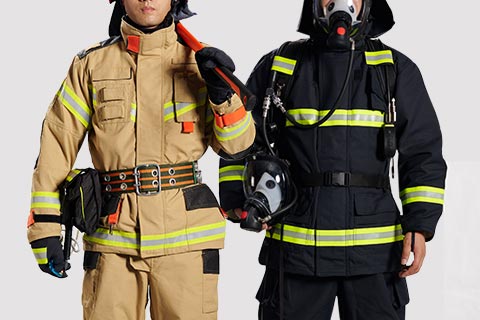

How Fire Suit Breathability Affects Firefighter Heat Stress
In firefighting and rescue sites with high-temperature, thick smoke and high-intensity operations, the safety risks faced by firefighters not only come from open flames, high-temperature radiation and toxic fumes, but heat stress injuries have long become one of the core hidden dangers that threaten the health of firefighters and affect operational efficiency.According to safety statistics in the firefighting industry, more than 60% of the physical overdrafts and physical discomfort symptoms of front-line firefighters during training and police attendance are related to heat stress caused by insufficient breathability of firefighting clothing.Many people only pay attention to the flame-retardant, puncture-proof, heat-insulating and protective properties of firefighting clothing, but ignore the core parameter of firefighting clothing breathability.In fact, breathability directly determines the efficiency of heat and moisture discharge inside the clothing, and accurately affects the body temperature regulation, physical fitness status and operating endurance of firefighters.
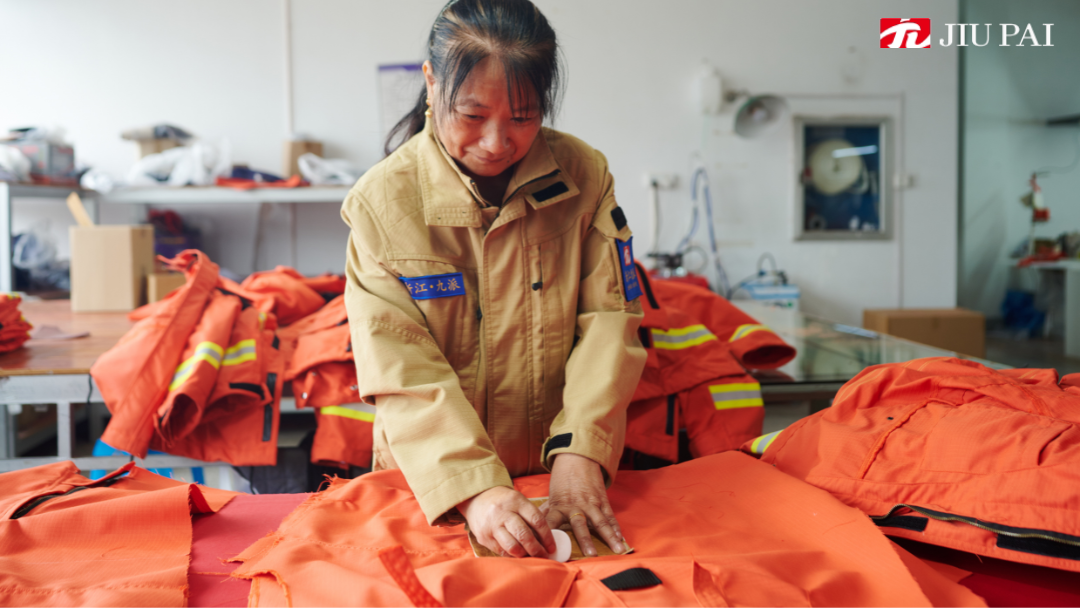
What Causes Heat Stress Inside a Fire Suit
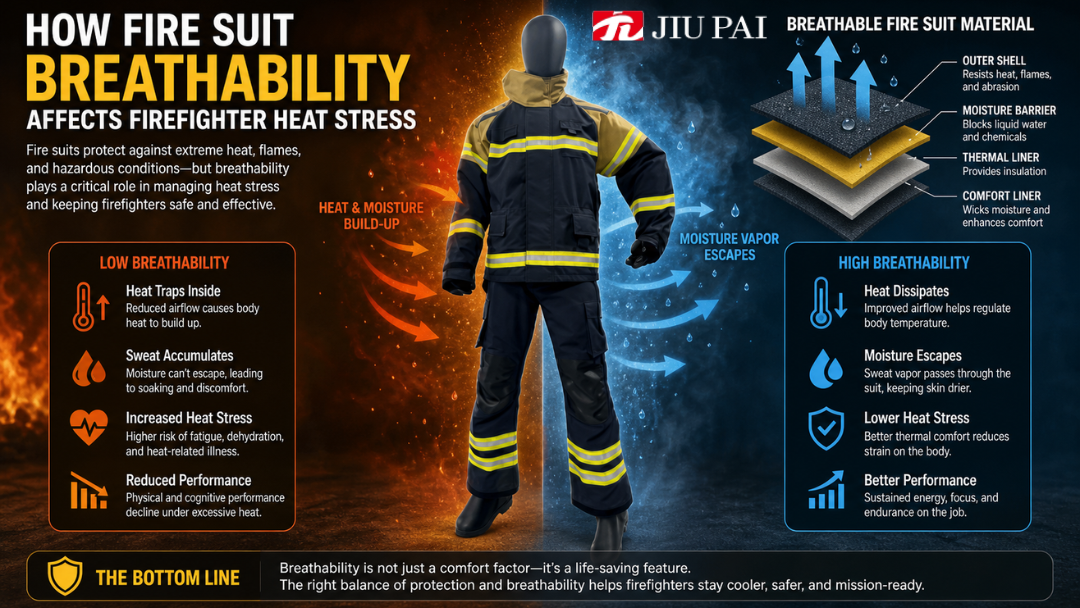
There will be a double accumulation problem inside the firefighting clothing quickly. On the one hand, the waste heat generated by the human body's metabolism and the high-temperature heat from the outside world cannot be dissipated in time, and it continues to accumulate between the clothing and the skin, resulting in a rapid increase in local temperature.On the other hand, a large amount of sweat secreted by the human body under high-intensity exercise cannot spread outward and continues to accumulate on the inner layer of clothing and the surface of the skin.The double accumulation of heat and moisture will directly break the body's body temperature balance, induce mild sultry heat and fatigue, and gradually escalate into heatstroke, heat cramps, heat exhaustion and other heat stress symptoms of varying degrees. In severe cases, it will directly cause firefighters to lose their ability to operate and cause safety accidents.
For firefighters, the duration of fire operations is long, the intensity of exercise is high, the ambient temperature is extremely high, and the body's heat dissipation requirements are much higher than in ordinary scenes.At this time, the evaporation efficiency of sweat directly determines the fireman's heat resistance and operating endurance.If the sweat cannot evaporate normally, the body's heat dissipation channel is blocked. Even if you continue to sweat profusely, it will not be able to cool down. On the contrary, heat will continue to accumulate in the body, quickly triggering a heat stress response.It can be said that the breathability of firefighting clothing is essentially a key barrier to ensure the normal operation of the human sweat evaporation and heat dissipation mechanism in extreme scenarios.
From the level of operation safety and equipment performance, moisture retention will greatly reduce the comprehensive protection ability of firefighting clothing.The thermal conductivity of wet fabrics will be greatly improved, and the high temperature heat from the outside world will more easily penetrate the clothing and transmit it to the human body, increasing the heating rate.At the same time, moisture will soften the protective fibers of the fabric, and long-term dry and wet alternation will accelerate the aging and wear of clothing, reducing flame retardant and tear resistance.In addition, wet clothing will cling to the skin, greatly limiting the flexibility of physical movement, directly affecting firefighters' climbing, demolition, search and rescue and other key operations, greatly increasing the risk of rescue.
After the sweat generated by firefighters during their operations evaporates into water vapor on the surface of the skin, it can penetrate out layer by layer through the microscopic breathable pores of the firefighting clothing fabric and quickly discharge out of the microenvironment inside the clothing, reducing heat and moisture accumulation from the root cause.The continuous water vapor discharge process will simultaneously take away excess heat from the surface of the body, maintain a dry and constant temperature state inside the clothing, effectively inhibit the rapid increase in body temperature, and significantly delay the occurrence of heat stress, so that firefighters can maintain a stable physical fitness and operating state for a long time.
The third layer of fire suit is the thermal insulation layer, which is made of fluffy and breathable thermal insulation fiber material, which blocks the inward conduction of external high temperature heat through the air sandwich. At the same time, the fluffy structure does not clog the ventilation channel and does not affect the discharge of water vapor.The innermost layer is a skin-friendly and comfortable lining, which is soft and skin-friendly, and quickly conducts moisture. It can quickly export sweat from the surface of the skin, avoid sweat sticking to the skin, and further improve the efficiency of evaporation and heat dissipation.The scientific collocation of the four-layer structure fundamentally improves the problems of insufficient protection and insufficient ventilation of traditional heavy protective clothing, and realizes the effect of layer-by-layer moisture conduction and layer-by-layer heat dissipation.
Professional and formal firefighting clothing manufacturing, relying on mature fabric matching technology, composite technology and structural design, to achieve a precise balance between the two.On the basis of strictly complying with the national firefighting equipment protection standards and ensuring the core protective properties of flame retardant, heat insulation, waterproof and tear-proof, the pore structure of the fabric is optimized, the material density of each layer is adjusted, and the splicing process is improved to maximize the efficiency of water vapor circulation.It will neither sacrifice protection and safety due to the breathable design, nor cause sultry heat and sweat due to the protective structure. It fundamentally solves the problem of heat stress for firefighters, taking into account safety protection and operating experience.
The outer layers of low-end firefighting clothing mostly use high-density compaction weaving technology, or inferior heavy fabrics. Although the wear-resistant and flame-retardant properties seem to be up to standard, the pores of the fabric are very small, the breathability is extremely poor, the water vapor penetration resistance is greatly increased, and the internal moisture cannot be discharged in time. It is one of the main reasons for the stuffy clothing.At the same time, the waterproof and antifouling coating process of the outer fabric will also affect the breathability, and the overly heavy coating will clog the breathable pores and greatly reduce the moisture permeability efficiency.
For buyers of firefighting equipment, only by abandoning the misunderstanding of single-parameter selection, in-depth understanding of the influencing factors of breathability, performance standards and purchase logic, and strictly verifying the technical parameters and qualifications of manufacturers can they choose high-quality firefighting suits with a two-way balance of protection and breathability, and maximize the protection of the physical health and operational safety of front-line firefighters from the equipment level, and enhance the overall combat capabilities of the firefighting team.
What Causes Heat Stress Inside a Fire Suit
Heat and moisture buildup
In high-intensity operations such as fire fighting, rescue, search and rescue, the body of firefighters will continue to produce a lot of metabolic heat, while the high-temperature radiation and heat convection of the fire environment will continue to transmit external heat to the human body.Under normal circumstances, the human body can maintain a constant body temperature through skin heat dissipation and sweat evaporation, but firefighting clothing with too strong air tightness and insufficient breathability will form a closed microenvironment.There will be a double accumulation problem inside the firefighting clothing quickly. On the one hand, the waste heat generated by the human body's metabolism and the high-temperature heat from the outside world cannot be dissipated in time, and it continues to accumulate between the clothing and the skin, resulting in a rapid increase in local temperature.On the other hand, a large amount of sweat secreted by the human body under high-intensity exercise cannot spread outward and continues to accumulate on the inner layer of clothing and the surface of the skin.The double accumulation of heat and moisture will directly break the body's body temperature balance, induce mild sultry heat and fatigue, and gradually escalate into heatstroke, heat cramps, heat exhaustion and other heat stress symptoms of varying degrees. In severe cases, it will directly cause firefighters to lose their ability to operate and cause safety accidents.
Why sweat evaporation matters
Sweat evaporation is the most important and efficient way of heat dissipation in the human body's high temperature environment, and it is also the key mechanism for the human body to self-regulate body temperature.The sweat produced by the human body in high-intensity exercise and high-temperature environments evaporates through the surface of the skin, which can take away a lot of surface heat, quickly reduce the surface temperature of the skin, maintain the stability of the body's core body temperature, and ensure the normal operation of body functions.For firefighters, the duration of fire operations is long, the intensity of exercise is high, the ambient temperature is extremely high, and the body's heat dissipation requirements are much higher than in ordinary scenes.At this time, the evaporation efficiency of sweat directly determines the fireman's heat resistance and operating endurance.If the sweat cannot evaporate normally, the body's heat dissipation channel is blocked. Even if you continue to sweat profusely, it will not be able to cool down. On the contrary, heat will continue to accumulate in the body, quickly triggering a heat stress response.It can be said that the breathability of firefighting clothing is essentially a key barrier to ensure the normal operation of the human sweat evaporation and heat dissipation mechanism in extreme scenarios.
Effects of trapped moisture
The inability to discharge and long-term retention of moisture inside the firefighting clothing will have a double negative impact on the physical condition of the firefighters and the protective performance of the clothing.From the level of human body's somatosensory and health, the retained moisture will wrap the skin, destroy the breathable circulation on the surface of the skin, and cause the skin to be in a humid and sultry state for a long time. It will not only cause skin itching, eczema, sultry tingling and other discomfort, but also accelerate physical exertion, causing firefighters to experience fatigue, dizziness, inattention and other problems faster.From the level of operation safety and equipment performance, moisture retention will greatly reduce the comprehensive protection ability of firefighting clothing.The thermal conductivity of wet fabrics will be greatly improved, and the high temperature heat from the outside world will more easily penetrate the clothing and transmit it to the human body, increasing the heating rate.At the same time, moisture will soften the protective fibers of the fabric, and long-term dry and wet alternation will accelerate the aging and wear of clothing, reducing flame retardant and tear resistance.In addition, wet clothing will cling to the skin, greatly limiting the flexibility of physical movement, directly affecting firefighters' climbing, demolition, search and rescue and other key operations, greatly increasing the risk of rescue.
How Fire Suit Breathability Helps Manage Heat
Moisture vapor escape
The core advantage of high-quality breathable firefighting clothing is the construction of a one-way and efficient water vapor escape channel, which is perfectly adapted to the extreme operating environment of high temperature and humidity in the fire site.Different from the simple breathable design of ordinary protective clothing, the breathability of professional firefighting clothing is not undifferentiated ventilation, but under the premise of isolating open flames, high temperature, and flue gas, it realizes the precise breathable effect of waterproof and moisture-permeable.After the sweat generated by firefighters during their operations evaporates into water vapor on the surface of the skin, it can penetrate out layer by layer through the microscopic breathable pores of the firefighting clothing fabric and quickly discharge out of the microenvironment inside the clothing, reducing heat and moisture accumulation from the root cause.The continuous water vapor discharge process will simultaneously take away excess heat from the surface of the body, maintain a dry and constant temperature state inside the clothing, effectively inhibit the rapid increase in body temperature, and significantly delay the occurrence of heat stress, so that firefighters can maintain a stable physical fitness and operating state for a long time.
Four-layer construction
The formal and professional firefighting and rescue firefighting suits on the market are all designed with a four-layer composite structure. The material, density, and craftsmanship of each layer of fabric are precisely matched, taking into account the protection and breathability. It is the core foundation for achieving efficient heat dissipation and ventilation. The four-layer structure performs its duties and works together. The outer layer is a flame-retardant and wear-resistant protective layer, made of high-strength flame-retardant fiber fabric, which has the characteristics of anti-open flame, anti-radiant heat, anti-tear, and wear-resistant. At the same time, the fabric reserves uniform micro-breathable pores, allowing gaseous water vapor to penetrate and block liquid water droplets, open flames, and high-temperature particles.The second layer in the middle is a waterproof and moisture-permeable barrier layer, which is the core layer of breathable protection. It can block external rainwater, stagnant water in the fire site, and liquid pollutants, while ensuring the rapid penetration of internal water vapor and preventing moisture retention.The third layer of fire suit is the thermal insulation layer, which is made of fluffy and breathable thermal insulation fiber material, which blocks the inward conduction of external high temperature heat through the air sandwich. At the same time, the fluffy structure does not clog the ventilation channel and does not affect the discharge of water vapor.The innermost layer is a skin-friendly and comfortable lining, which is soft and skin-friendly, and quickly conducts moisture. It can quickly export sweat from the surface of the skin, avoid sweat sticking to the skin, and further improve the efficiency of evaporation and heat dissipation.The scientific collocation of the four-layer structure fundamentally improves the problems of insufficient protection and insufficient ventilation of traditional heavy protective clothing, and realizes the effect of layer-by-layer moisture conduction and layer-by-layer heat dissipation.
Balancing breathability and protection
The core difficulty of the research and development and production of firefighting equipment is to balance breathability and safety protection.Many low-end firefighting suits have obvious shortcomings, either they over-pursue lightness and breathability, simplify the protective structure, and reduce the fabric standards, resulting in substandard flame-retardant, heat-insulating, and puncture-proof properties, and cannot withstand the extreme risks of fire.Either over-stacking protective fabrics, thickening structures, or blindly increasing the level of protection will eventually lead to excessive air tightness and poor breathability of clothing, and frequent heat stress problems.Professional and formal firefighting clothing manufacturing, relying on mature fabric matching technology, composite technology and structural design, to achieve a precise balance between the two.On the basis of strictly complying with the national firefighting equipment protection standards and ensuring the core protective properties of flame retardant, heat insulation, waterproof and tear-proof, the pore structure of the fabric is optimized, the material density of each layer is adjusted, and the splicing process is improved to maximize the efficiency of water vapor circulation.It will neither sacrifice protection and safety due to the breathable design, nor cause sultry heat and sweat due to the protective structure. It fundamentally solves the problem of heat stress for firefighters, taking into account safety protection and operating experience.
How Fire Suit Breathability Is Measured
The breathability of firefighting clothing is not a subjective somatosensory judgment, but relying on industry authoritative testing standards, it is accurately determined by two core quantitative parameters, namely THL and Ret. The combination of the two parameters can comprehensively and objectively reflect the breathable and heat dissipation capacity of firefighting clothing.THL
Total heat loss is the core index to measure the overall heat dissipation capacity of firefighting clothing. The unit is W/㎡, which represents the total heat that the clothing can emit per unit area in the standard testing environment, covering two forms of dry heat dissipation and wet heat dissipation.The higher the THL value, the stronger the overall heat dissipation performance of the firefighting suit, the faster the heat and moisture discharge efficiency, the less likely it is for firefighters to accumulate heat during operation, and the stronger the resistance to heat stress.According to domestic firefighting equipment testing standards, the THL value of professional firefighting suits needs to reach the industry benchmark value or more in order to meet the heat dissipation needs of high-intensity fire operations.THL is the basic parameter to determine whether the firefighting suit is suitable for high-temperature operation scenarios, and it is also the core reference basis for procurement and selection.Ret
Evaporative Resistance is specially used to measure the degree of obstruction of water vapor evaporation by firefighting clothing, in ㎡·Pa/W.This parameter directly corresponds to the breathable and moisture-permeable ability of the garment, and accurately reflects the difficulty of penetrating and discharging sweat and water vapor.Contrary to the logic of THL values, the lower the Ret value, the better.The lower the Ret value, the less hindrance the garment has to water vapor, the faster the sweat evaporates and the water vapor is released, and the less likely the internal moisture is to stay.Conversely, the higher the Ret value, the greater the breathable resistance of the fabric, the poor discharge of water vapor, and the serious accumulation of moisture and heat, which can easily cause heat stress.This parameter is the key indicator to distinguish between ordinary protective clothing and professional fire rescue clothing, and can accurately identify the breathable shortcomings of clothing.THL and Ret together
Referring to a single parameter of THL or Ret alone, it is impossible to comprehensively determine the breathable and heat dissipation performance of firefighting clothing. Only by combining the two parameters can the comprehensive quality of clothing be accurately judged.Some inferior firefighting suits have one-sided advantages in parameters. The THL value of some products is up to standard, but the Ret value is too high, and the overall heat dissipation is acceptable, but the evaporation of water vapor is blocked, and the problem of stuffy heat and sweat will still occur during operation.There are also some products with qualified Ret values, but the THL values are low, and the ventilation is acceptable, but the overall heat dissipation capacity is insufficient, and the heat accumulation speed is fast in high temperature environments.High-quality professional firefighting clothing must meet the parameter standards of high THL and low Ret at the same time. It not only has a strong overall heat dissipation capacity, but also guarantees the rapid evaporation and discharge of water vapor, and comprehensively resists heat stress from the two dimensions of dry heat and wet heat, and is suitable for long-term and high-intensity fire rescue operations.What Factors Affect Fire Suit Breathability
The breathability of firefighting clothing is determined by the overall system. It is not a single fabric performance. It covers multiple core factors such as four-level fabric material, clothing layout technology, operation scenario and workload. Problems in any link will directly reduce the overall breathable and heat dissipation effect.Outer layer
The outer layer of firefighting clothing is the first layer structure that comes into contact with the external environment, and its fabric material, fiber density, and weaving technology directly determine the basic breathable performance.The high-quality outer layer mostly uses high-end flame-retardant fibers such as aramid and flame-retardant polyester, and adopts a loose and uniform weaving process. Under the premise of ensuring wear resistance, tear resistance, and flame retardant, it retains stable breathable pores and does not hinder the discharge of water vapor.The outer layers of low-end firefighting clothing mostly use high-density compaction weaving technology, or inferior heavy fabrics. Although the wear-resistant and flame-retardant properties seem to be up to standard, the pores of the fabric are very small, the breathability is extremely poor, the water vapor penetration resistance is greatly increased, and the internal moisture cannot be discharged in time. It is one of the main reasons for the stuffy clothing.At the same time, the waterproof and antifouling coating process of the outer fabric will also affect the breathability, and the overly heavy coating will clog the breathable pores and greatly reduce the moisture permeability efficiency.
Moisture Barrier
The moisture-proof barrier layer of Fire suit is the core key layer that balances waterproofing and breathability, and it is also the core component that affects breathability.The high-quality barrier layer is made of microporous breathable membrane material. The microscopic pores allow water vapor to penetrate freely, while effectively blocking liquid water, fire impurities and toxic droplets, and taking into account both waterproof and breathable properties.The inferior barrier layer mostly uses ordinary waterproof cloth and non-porous sealing film. Although the waterproof effect is up to standard, it completely blocks the water vapor channel, and the sweat and water vapor produced by the human body cannot be discharged. All silt up inside the clothing, and there will be serious sultry heat and perspiration problems in a short period of time, and the risk of heat stress is greatly increased.In addition, the bonding process of the barrier layer is also very important. If the bonding is too tight and the adhesive layer is too thick, it will clog the breathable pores and reduce the breathable efficiency.Thermal Barrier
The core role of the fire suit heat insulation layer is to block the inward conduction of external high temperature heat, and its fluffiness, fiber structure, and thickness directly affect the breathability.The high-quality heat insulation layer adopts ultra-fine fluffy flame-retardant fibers, with uniform fiber gaps and good air circulation. It can not only use the air sandwich to achieve efficient heat insulation, but also will not clog the water vapor channel to ensure the normal dissipation of heat and moisture.If the insulation layer fabric is too heavy, compacted, and the fiber gap is too small, it will not only increase the weight of the garment and reduce flexibility, but also directly block the ventilation and heat dissipation channel, resulting in internal heat cannot be dissipated and moisture accumulates.At the same time, the poor-quality thermal insulation layer will have compaction and collapse problems after long-term use, and the breathable performance will continue to decline, and the hidden dangers of heat stress will become more and more obvious.Inner Layer
The inner fabric of Fire suit directly contacts human skin, and its core role is to guide moisture and wicking, improve somatosensory comfort, and indirectly affect the overall ventilation and heat dissipation efficiency.The high-quality inner layer adopts skin-friendly, moisture-conducting and quick-drying fabrics, which can quickly absorb sweat from the surface of the skin, and quickly export liquid sweat to the outer structure for evaporation, avoiding sweat from sticking to the skin and accumulating in the inner layer of clothing, and speeding up the heat dissipation cycle.The inner layer of ordinary cotton and inferior chemical fiber has poor moisture absorption and weak moisture conductivity. Sweat will stick to the skin and the inner layer for a long time, and cannot be quickly exported and evaporated. Even if the outer layer has good air permeability, there will be local perspiration and sultry heat, which will affect the overall heat dissipation effect and reduce the comfort of firefighters.Suit fit and construction
Under the premise that the fabric performance is up to standard, the clothing layout design, stitching technology, and elastic structure will directly affect the air circulation efficiency and determine the actual breathable experience.firefighting clothing that is too tight-fitting and has insufficient margin will cling to the human skin, compressing the breathable sandwich space inside the clothing, the air cannot circulate normally, and the heat and moisture are difficult to diffuse and discharge.If the version is too loose, it will lead to insufficient protective fit and affect the flexibility of the operation.At the same time, the stitching process, stitch density, velcro, cuffs, and hem tightening design of clothing are also essential.Excessive sealing splicing, dense pins, and fully enclosed tightening structure will greatly reduce the air convection channel of clothing and reduce the overall breathability.The professional process design will reserve a reasonable air convection space to optimize the overall ventilation circulation effect under the premise of ensuring protection.Workload and environment
The external work scene and the workload of the human body will directly amplify the difference between the advantages and disadvantages of breathability.In high-intensity work scenarios, firefighters exercise a lot and have a high heart rate. The body's heat production and sweating have increased exponentially. The requirements for fire suit's breathable and heat dissipation speed have been greatly increased. Clothing with insufficient breathability will quickly accumulate heat, inducing heat stress.In a high-temperature, high-humidity, and confined fire environment, the external air has high humidity and high temperature, and the natural heat dissipation conditions are poor. The load on the clothing ventilation system increases sharply, and the ventilation shortcomings of inferior clothing will be completely exposed.In conventional operating scenarios with ventilation and low temperature, the problem of heat stress is relatively inconspicuous.This is also the core reason why the same firefighting suit is acceptable in daily training, and there will be severe heat and discomfort in the actual combat fire field.How to Choose a More Breathable Firefighter Suit
Look beyond one metric
When purchasing and selecting models, do not judge the quality of clothing based on a single breathable parameter and publicity technique. A single parameter that meets the standards cannot guarantee the comprehensive breathable and heat dissipation effect.Many manufacturers will deliberately promote a single high THL or low Ret data to mask the shortcomings of another parameter, resulting in a very poor actual use experience of clothing.Professional selection must combine the two core parameters of THL and Ret for comprehensive determination, and give priority to products with high total heat loss and low evaporation resistance. At the same time, it combines fabric material, four-layer structure technology, and multi-dimensional evaluation of measured somatosensory data to eliminate parameter traps and ensure that the breathable and heat dissipation performance of clothing is true, stable and reliable.Match the operating environment
The requirements for the breathability and protection of firefighting clothing in different job scenarios vary greatly, and the selection needs to accurately match the core job scenarios of the team.For high-temperature, high-humidity and high-intensity operation scenarios such as urban high-rise fire extinguishing, confined space rescue, and high-temperature plant operations, priority needs to be given to professional firefighting suits with high breathability and high heat dissipation, focusing on strengthening heat stress protection capabilities.For outdoor low-temperature rescue, field rescue, routine inspections and other scenarios, it can properly balance breathability, warmth, and wear resistance.Precise matching of scene selection can not only avoid the problem of heat stress caused by insufficient ventilation, but also avoid the excessive pursuit of high ventilation leading to insufficient protection performance, and achieve the dual optimal solution of cost performance and practicality.Check the complete suit system
The breathability of firefighting clothing is the overall performance of the entire system, not the independent performance of a single top and pants. The selection must verify the configuration of a full set of equipment, including the main body of firefighting clothing, protective gloves, protective boots, helmet lining, protective belts and other supporting components.Even if the main body of the garment has excellent air permeability, if the air tightness of the supporting equipment is too high and the air permeability is not smooth, it will still cause the overall heat dissipation cycle to be blocked, and local heat accumulation and perspiration problems will occur.When purchasing, it is necessary to evaluate the ventilation design and ventilation structure of the complete set of equipment as a whole to ensure that the heat and humidity exchange of the complete set of protection systems is smooth, and the risk of heat stress is avoided in all directions.Balance protection and breathability
The improvement of breathable performance must not be at the expense of core protective performance.In the selection process, priority must be given to ensuring that the core protection indicators of fire-retardant, heat-insulating, puncture-proof, waterproof, and tear-resistant firefighting clothing fully comply with national GB standards and industry specifications, and have formal testing and certification.On the basis of up-to-standard protection performance, choose products with better ventilation and heat dissipation parameters, more mature technology, and more comfortable somatosensory, so as to avoid the selection misunderstanding of blindly pursuing breathability and ignoring the core protection performance, not only to ensure the safety of firefighters in extreme fire scenes, but also to effectively reduce heat stress injuries, and achieve a two-way balance between safety and experience.Conclusion
The breathability of firefighting clothing is the core key parameter that determines the risk of heat stress, operational efficiency, physical endurance and operational safety of firefighters, and it is by no means an irrelevant auxiliary performance.The accumulation of heat and moisture, and the blocked evaporation of sweat are the core causes of heat stress, and the high-quality four-layer structure, reasonable process design, and excellent THL and Ret parameters are the core foundations for ensuring that clothing is breathable, dissipates heat, and resists heat stress.For buyers of firefighting equipment, only by abandoning the misunderstanding of single-parameter selection, in-depth understanding of the influencing factors of breathability, performance standards and purchase logic, and strictly verifying the technical parameters and qualifications of manufacturers can they choose high-quality firefighting suits with a two-way balance of protection and breathability, and maximize the protection of the physical health and operational safety of front-line firefighters from the equipment level, and enhance the overall combat capabilities of the firefighting team.
Next Article:
Last Article:
Request A Quote
Related News
Quick Consultation
We are looking forward to providing you with a very professional service. For any
further information or queries please feel free to contact us.