

How to Test Flame Retardant Properties in Fire Suit Fabrics
Firefighters face the threat of high temperature and open flames in the fire scene, and the flame retardant performance of firefighting clothing is the key to life protection. Flame retardant testing of firefighting clothing fabrics is the core of equipment safety and compliance, and is also an important part of production and procurement. This article will explain its flame retardant properties, core testing methods, processes and results interpretation, to provide you with professional reference.
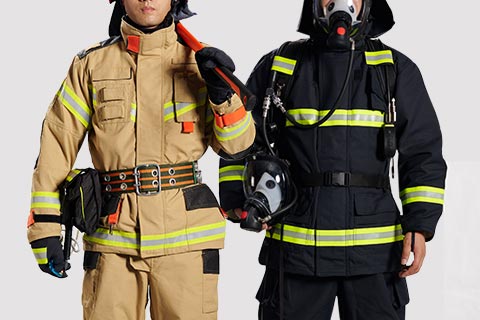
Firefighting clothing using multi-layer composite structure, protective fabrics, each layer of the division of labor synergistic, indispensable. The outer shell is resistant to open flame, wear-resistant, anti-melting droplets, direct flame impact. The heat insulation layer blocks high temperature conduction and reduces heat transfer. The moisture-proof layer takes into account both heat and moisture, preventing water vapor condensation and high-temperature water vapor intrusion, and jointly building a complete flame retardant protection system.
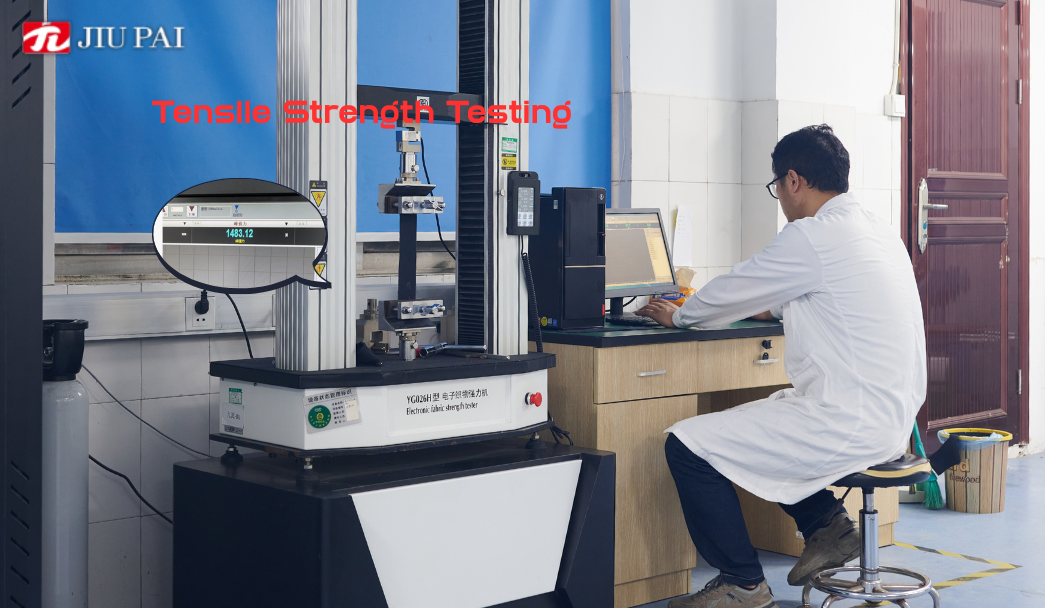
The operation method of the test has strict industry norms, the standard size of the fabric samples will be fixed vertically, with the prescribed flame in the sample below the continuous contact for 10 seconds and then removed, and then accurately measure the flaming time, flameless burning time, and the length of the destruction of the fabric after combustion, the CE standard requires that flaming combustion ≤ 2 seconds, flameless burning ≤ 2 seconds, and the length of the destruction of ≤ 150mm.
The importance of this test cannot be overstated, as it directly verifies the basic flame retardancy of all layers of firefighting clothing. If the fabric can not self-extinguish after contact with an open flame, the flame will spread rapidly, and the fire suit will lose its protective effect; the fabric that can successfully pass the test will stop burning quickly after the fire is withdrawn, thus avoiding the flame from the root of the firefighters' direct burns.
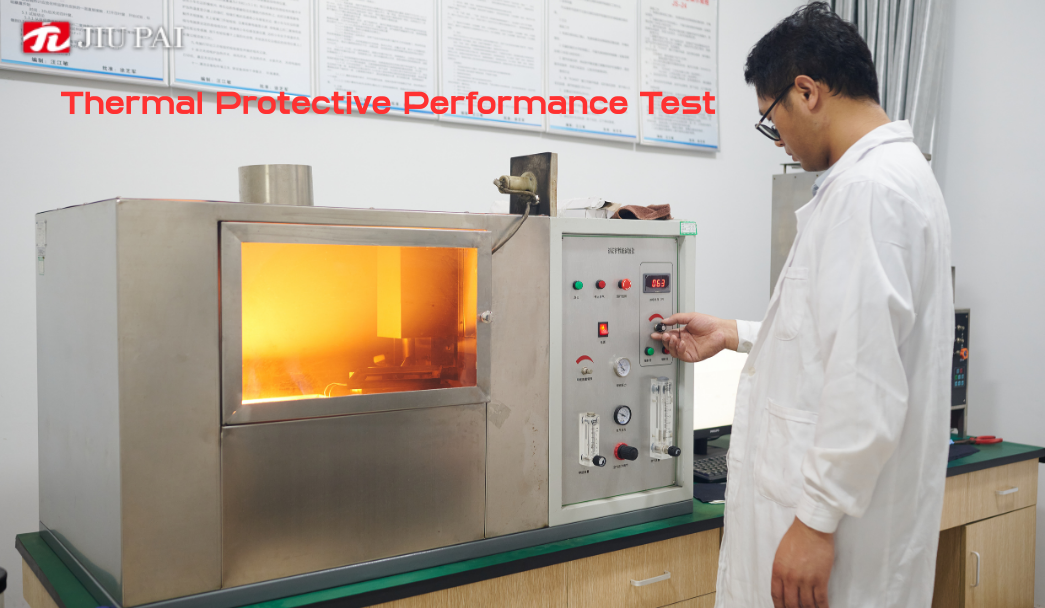
During the test, the fabric sample is placed in front of the standard radiant heat panel, and the high-precision heat sensor is pressed against the inner side of the fabric to monitor the conduction speed and temperature change of heat through the fabric in real time, and then the heat penetration index of the fabric is finally calculated through the data, so as to determine the level of thermal protection, and the CE standard requires that the radiant heat protection index (RHTI) ≥ 21 seconds, and the convective heat protection index (HTI24) ≥ 13 seconds.
This is a measure of the core indicators of firefighter fabric safety, high-quality firefighting clothing fabrics can effectively block the strong radiant heat of the fire, significantly delaying the heat conduction to the human body time, for firefighters to complete the task of the fire, the evacuation of the dangerous area to fight for valuable time, so that the protection of a more close to the actual combat.
In the test process, the fabric samples will be in direct contact with the heated metal plate at a set temperature, and the time for the heat to pass through the fabric and reach the critical burn temperature of the human body will be accurately recorded by the professional equipment, and the longer the contact time is, the better the contact heat protection performance of the fabric is, and the CE standard requires that under the contact condition of 250℃, the time for the temperature to rise by 10℃ is ≥7 seconds.
The significance of the contact heat test is to fit the real operation scene of the fire scene, firefighters will inevitably come into contact with the high temperature of the fire equipment, metal pipes and the surface of the burning material when they extinguish the fire, the fabrics through this test can effectively reduce the scald brought about by this kind of short-term high temperature contact, so as to make the protection more detailed and more practical.
Sample Preparation: As the basis of testing, we need to perform environmental humidification on the fabrics according to CE standards, and leave them in the natural state in the specified temperature and humidity environment. CE standards require that the humidification conditions be at a temperature of 23±2℃ and a humidity of 50±5%, and leave them in the natural state for 24 hours, and then we need to cut the samples with accurate dimensions and no breakage and folds according to the different testing standards and make clear the direction of the cuts, so that we can avoid the testing bias caused by the sample problems.
Laboratory setup: We need to match the core requirements of each test item, equip corresponding professional equipment according to CE standards and calibrate them in advance, such as vertical combustion test needs standard flame source, fixing frame and timing measurement tools, radiant heat test needs high-precision sensors and data acquisition system, equipment error needs to be ≤±1℃, the accuracy of the equipment has a direct impact on the test results.
Data collection and evaluation: As the final part of the test, key data such as combustion time and damage length should be recorded in real time, and then analyzed professionally according to the CE standard, not only to determine the compliance of fabrics, but also to evaluate the advantages and disadvantages of flame-retardant properties, and Grade 1 and Grade 2 fabrics need to satisfy the corresponding CE numerical requirements, so as to provide reliable data support for the optimization and selection of fabrics.
According to CE standards, the flame retardant performance of fire clothing fabrics is categorized into Grade I and Grade II. Grade I fabrics have better protection, short flaming and flameless burning time after contact with open flame, small length of damage, and strong ability to block radiant heat and contact heat, specifically flaming ≤ 1 second, RHTI ≥ 28 seconds. Grade II fabrics meet the basic flame retardant standards, with slightly weaker protection, applicable to scenes with lower fire risk, corresponding to flaming combustion ≤ 2 seconds, RHTI ≥ 21 seconds.
The core of the flame retardant grade division is to realize the configuration according to the needs, the first grade fabric is suitable for the first line of fire fighting and rescue, and can cope with the large-scale high temperature fire scene. The second level of fabric is suitable for fire inspection, emergency watch and other low-risk operations, taking into account the safety and practicality. Interpretation of the results need to pay attention to the comprehensive performance, to avoid a single test is excellent but the protection has a short board situation.
The flame retardant test of firefighting clothing fabrics is an important line of defense for guarding firefighters' lives and safety. Vertical combustion, radiant heat protection performance and other core tests verify the actual protection capability of flame retardant fabrics from different dimensions, while the standardized test process and professional interpretation of results make the flame retardant test really play its due role.
Here we also call on all fire suit manufacturers to adhere to the bottom line of quality, strictly do a good job in every flame retardant test, and all purchasers to strictly control the selection of models, recognizing the compliance test report. So that every piece of fire suit can meet the high standards of flame retardant requirements for firefighters to build an impenetrable flame defense, so that they can be steadily guarded while guarding people's lives and property safety!
Flame Retardant Properties in Fire Suit Fabrics
Do a good job of fire clothing fabric flame retardant test, you need to clarify the flame retardant properties of the fabric, the type of fire clothing material and structure is to determine the fundamental flame retardant effect. Flame-retardant fabrics are divided into inherent flame-retardant fibers and chemically treated fabrics, the former molecular structure with flame retardant, non-melt droplet characteristics, flame retardant effect is long-lasting. The latter cost is lower, but the protective effect will decline with the number of uses, the stability is poor.Firefighting clothing using multi-layer composite structure, protective fabrics, each layer of the division of labor synergistic, indispensable. The outer shell is resistant to open flame, wear-resistant, anti-melting droplets, direct flame impact. The heat insulation layer blocks high temperature conduction and reduces heat transfer. The moisture-proof layer takes into account both heat and moisture, preventing water vapor condensation and high-temperature water vapor intrusion, and jointly building a complete flame retardant protection system.
Key Flame Retardant Tests for Fire Suits
The flame retardant protection ability of firefighting clothing fabrics can not rely on a single test to conclude that a number of tests are needed to form a comprehensive evaluation system, and different tests correspond to different fire scenarios in the fire scene. We focus on 2-3 core tests, through professional testing to make the results of fire suit flame retardant test more in line with the needs of the actual combat.Vertical burning test
Vertical combustion test is the key to check the basic flame retardant ability of fire clothing fabrics, and it is also the entry-level performance screening standard of flame retardant fabrics, the core purpose is to see whether the fabrics can extinguish by themselves after contacting with open flame.The operation method of the test has strict industry norms, the standard size of the fabric samples will be fixed vertically, with the prescribed flame in the sample below the continuous contact for 10 seconds and then removed, and then accurately measure the flaming time, flameless burning time, and the length of the destruction of the fabric after combustion, the CE standard requires that flaming combustion ≤ 2 seconds, flameless burning ≤ 2 seconds, and the length of the destruction of ≤ 150mm.
The importance of this test cannot be overstated, as it directly verifies the basic flame retardancy of all layers of firefighting clothing. If the fabric can not self-extinguish after contact with an open flame, the flame will spread rapidly, and the fire suit will lose its protective effect; the fabric that can successfully pass the test will stop burning quickly after the fire is withdrawn, thus avoiding the flame from the root of the firefighters' direct burns.
Thermal Protective Performance Test
In the fire, the damage caused by radiant heat is often no less than an open fire, the thermal protection test is specifically to assess the ability of the fabric to block radiant heat of the core project, but also to simulate the real fire high-temperature environment of the important test.During the test, the fabric sample is placed in front of the standard radiant heat panel, and the high-precision heat sensor is pressed against the inner side of the fabric to monitor the conduction speed and temperature change of heat through the fabric in real time, and then the heat penetration index of the fabric is finally calculated through the data, so as to determine the level of thermal protection, and the CE standard requires that the radiant heat protection index (RHTI) ≥ 21 seconds, and the convective heat protection index (HTI24) ≥ 13 seconds.
This is a measure of the core indicators of firefighter fabric safety, high-quality firefighting clothing fabrics can effectively block the strong radiant heat of the fire, significantly delaying the heat conduction to the human body time, for firefighters to complete the task of the fire, the evacuation of the dangerous area to fight for valuable time, so that the protection of a more close to the actual combat.
Contact Heat Test
The contact heat test is an important supplement to the flame retardant core test, which mainly evaluates the protection ability of the fabric when it briefly comes into contact with hot surfaces at high temperatures, making the protection test of firefighting clothing more comprehensive.In the test process, the fabric samples will be in direct contact with the heated metal plate at a set temperature, and the time for the heat to pass through the fabric and reach the critical burn temperature of the human body will be accurately recorded by the professional equipment, and the longer the contact time is, the better the contact heat protection performance of the fabric is, and the CE standard requires that under the contact condition of 250℃, the time for the temperature to rise by 10℃ is ≥7 seconds.
The significance of the contact heat test is to fit the real operation scene of the fire scene, firefighters will inevitably come into contact with the high temperature of the fire equipment, metal pipes and the surface of the burning material when they extinguish the fire, the fabrics through this test can effectively reduce the scald brought about by this kind of short-term high temperature contact, so as to make the protection more detailed and more practical.
Fire Clothing Flame Retardant Test Process
Want to make the flame retardant test results of fire clothing fabrics accurate and informative, must follow the standardized testing process, each link of the standardized operation is the core requirements of the fire clothing testing process, to ensure that the data can truly reflect the actual flame retardant performance of the fabric.Sample Preparation: As the basis of testing, we need to perform environmental humidification on the fabrics according to CE standards, and leave them in the natural state in the specified temperature and humidity environment. CE standards require that the humidification conditions be at a temperature of 23±2℃ and a humidity of 50±5%, and leave them in the natural state for 24 hours, and then we need to cut the samples with accurate dimensions and no breakage and folds according to the different testing standards and make clear the direction of the cuts, so that we can avoid the testing bias caused by the sample problems.
Laboratory setup: We need to match the core requirements of each test item, equip corresponding professional equipment according to CE standards and calibrate them in advance, such as vertical combustion test needs standard flame source, fixing frame and timing measurement tools, radiant heat test needs high-precision sensors and data acquisition system, equipment error needs to be ≤±1℃, the accuracy of the equipment has a direct impact on the test results.
Data collection and evaluation: As the final part of the test, key data such as combustion time and damage length should be recorded in real time, and then analyzed professionally according to the CE standard, not only to determine the compliance of fabrics, but also to evaluate the advantages and disadvantages of flame-retardant properties, and Grade 1 and Grade 2 fabrics need to satisfy the corresponding CE numerical requirements, so as to provide reliable data support for the optimization and selection of fabrics.
Interpretation of Flame Retardant Test Results
After completing the flame retardant test, accurate interpretation of the test results is the key, different flame retardant level corresponds to different protective ability and use scenarios, a correct understanding of the performance evaluation data of the fire suit, in order to make the selection and use of fire apparel more in line with the actual needs.According to CE standards, the flame retardant performance of fire clothing fabrics is categorized into Grade I and Grade II. Grade I fabrics have better protection, short flaming and flameless burning time after contact with open flame, small length of damage, and strong ability to block radiant heat and contact heat, specifically flaming ≤ 1 second, RHTI ≥ 28 seconds. Grade II fabrics meet the basic flame retardant standards, with slightly weaker protection, applicable to scenes with lower fire risk, corresponding to flaming combustion ≤ 2 seconds, RHTI ≥ 21 seconds.
The core of the flame retardant grade division is to realize the configuration according to the needs, the first grade fabric is suitable for the first line of fire fighting and rescue, and can cope with the large-scale high temperature fire scene. The second level of fabric is suitable for fire inspection, emergency watch and other low-risk operations, taking into account the safety and practicality. Interpretation of the results need to pay attention to the comprehensive performance, to avoid a single test is excellent but the protection has a short board situation.
The flame retardant test of firefighting clothing fabrics is an important line of defense for guarding firefighters' lives and safety. Vertical combustion, radiant heat protection performance and other core tests verify the actual protection capability of flame retardant fabrics from different dimensions, while the standardized test process and professional interpretation of results make the flame retardant test really play its due role.
Here we also call on all fire suit manufacturers to adhere to the bottom line of quality, strictly do a good job in every flame retardant test, and all purchasers to strictly control the selection of models, recognizing the compliance test report. So that every piece of fire suit can meet the high standards of flame retardant requirements for firefighters to build an impenetrable flame defense, so that they can be steadily guarded while guarding people's lives and property safety!
Request A Quote
Related News
Quick Consultation
We are looking forward to providing you with a very professional service. For any
further information or queries please feel free to contact us.