
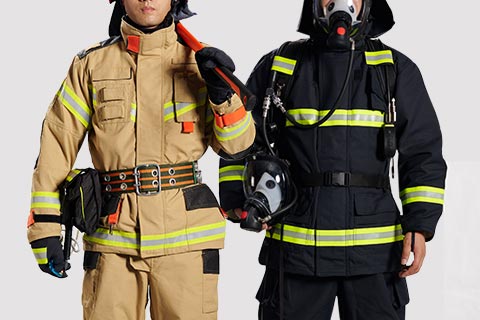

Fire Clothing Ideas: Best Materials for Extreme Work Conditions
Safety managers, purchasing departments and industrial buyers know the importance of selecting the right firefighting apparel materials for extreme operating environments. Failure to select the right material can reduce protection, comfort and equipment life, and in high-risk scenarios, can lead to safety hazards. This guide will break down the core requirements for protection, inventory quality heat-resistant fabrics, and explain certification programs to help build a professional protective clothing system for extreme working conditions.
The choice of fabrics directly determines the life, comfort and safety of firefighting protective clothing. Poor-quality fabrics are easy to break under extreme working conditions, loss of flame retardant and heat insulation function, endangering personnel safety. Suitable industrial protective equipment materials, not only to protect the safety, but also to take into account the wearing experience, to extend the life of the equipment, reduce procurement costs, is the core of the role of protective equipment.
This fabric has a wide range of applications and is commonly used in the outer layer of firefighting combat uniforms, the body of professional firefighting uniforms and the production of arc protection clothing for the electric power industry, and it is the core raw material for thermal protection clothing and aramid firefighting clothing. Its long service life and lightweight characteristics can also reduce the wearer's burden, suitable for long-term high-intensity rescue operations.
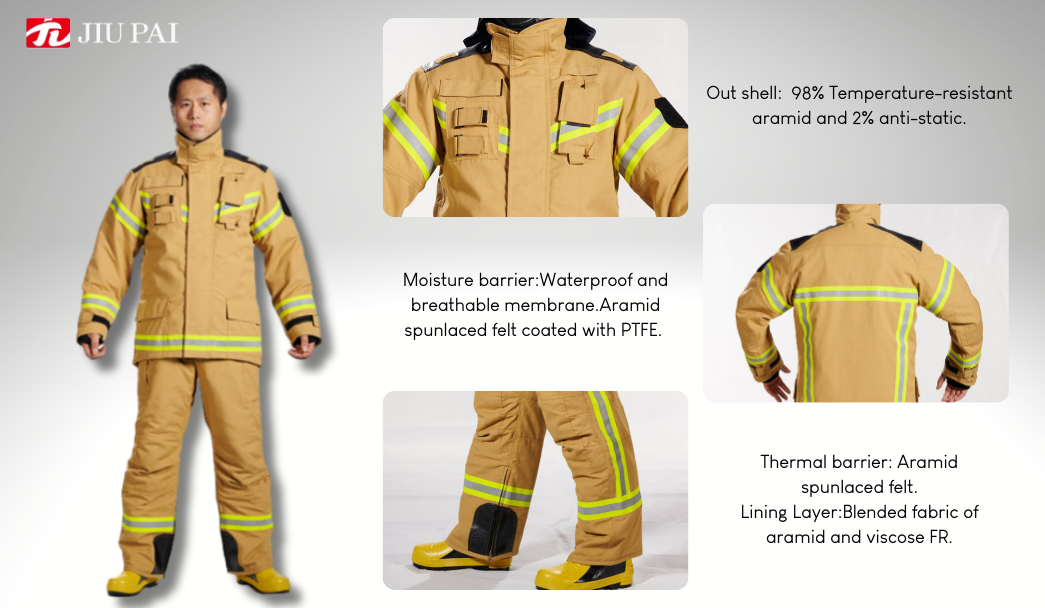
As the core fabric of high-end firefighting clothing, PBI fabric is the core composition of PBI fabric firefighting equipment, which can cope with the most demanding structure fire rescue, and is the preferred material for professional firefighting team's high-risk operations. Its excellent protective performance is irreplaceable, suitable for all kinds of high-end protection scene, is the extreme high-risk operations just need fabric.
It should be noted that flame retardant cotton has limited high temperature resistance and is not suitable for extreme fire rescue, but is more suitable for regular industrial fire prevention operations. It is used as the main raw material for flame-retardant cotton overalls and flame-retardant cotton jackets, which can meet the basic fire protection needs of small and medium-sized enterprises, taking into account the practicality and economy.
This fabric is mainly used in electric utilities, oil and gas extraction, general manufacturing and other fields, which can effectively meet the regular fire prevention and arc protection needs of such scenes, and it is the core fabric of modified acrylic fiber firefighting clothing, and at the same time, it is suitable for long-time operation, which can reduce the stiffness of the fabric and enhance the flexibility of the operation.
In bad rescue scenes, Kevlar reinforcement layer can provide excellent abrasion resistance, anti-cutting performance, to avoid easy to wear parts due to friction, cuts and scrapes fast breakage, effectively extend the overall service life of firefighting uniforms, Kevlar reinforcement of firefighting uniforms is a key component of the Kevlar, can be adapted to the ruins of the rescue, apparatus operation and other complex scenes, to ensure the integrity of the firefighting uniforms structure.
This kind of fabric can effectively isolate the accumulated water, chemical liquid and high temperature vapor in the fire scene, avoiding its contact with the skin to cause injury. Among them, the barrier layer made of PTFE and other materials is more advantageous, with certain breathable and moisture permeable performance, can block harmful substances at the same time, discharging moisture from the skin, to realize the protection and wearing comfort at the same time.
As a core component of firefighting clothing complying with EN469 and NFPA1971 international certification standards, firefighting clothing thermal lining is an essential part of professional firefighting combat uniforms, suitable for all kinds of high-temperature fire rescue. Relying on the excellent properties of inter-positional aramid and scientific quilting technology, it guarantees the core thermal insulation protection while taking into account the wearability and convenience, which helps the operators to carry out rescue work efficiently.
As a core component of the fire suit in accordance with EN469 and NFPA1971 international certification standards, the thermal lining of the fire suit is an essential part of the professional firefighting combat suit, which is suitable for all kinds of high-temperature fire rescue.
The outer layer is mainly responsible for flame retardant, wear-resistant, tear-resistant role, blocking direct contact with flames, external cuts and impact. The moisture-proof barrier layer isolates liquids and vapors and prevents harmful substances from penetrating. Thermal insulation lining blocks heat transfer, reducing the impact of high temperature on the body. The three layers of fabrics cooperate with each other to realize the multiple isolation of flame, heat and liquid.
Through the authoritative certification of fabrics and fire clothing, meaning that its performance has been rigorously tested by professional organizations, can effectively protect the safety of operators, to avoid the risk of protection failure due to substandard product quality, which is the core meaning of the procurement of fire clothing standard products.
For enterprises and firefighting teams, do not blindly purchase firefighting protective clothing, should be based on their own operational scenarios, operational needs, the choice of appropriate fabrics and multi-layer protection system, if necessary, can seek professional fabric manufacturers and protective equipment companies for fire clothing customized design and material consulting.
Safety is always the first premise of the operation, choose the authoritative certification, battle-proven quality fabrics, to create a professional fire protection system for the team, in order to maximize the protection of personnel safety in extreme working conditions, enhance operational efficiency. Starting from the selection of materials, the first gate of fire protection, so that every frontline operator can go to work with peace of mind and return safely.
Understanding Fire Clothing Requirements in Extreme Work Environments
Extreme operating environment covers a variety of high-risk scenarios such as high-temperature fire, petrochemical chemical corrosion, electric arc, wildfire fighting. Different scenarios of protective equipment needs are different, but the core are multiple safety protection, which is the core of the design of extreme conditions of firefighting equipment. Its performance key indicators of thermal protection, thermal insulation and other six categories, interrelated, indispensable.The choice of fabrics directly determines the life, comfort and safety of firefighting protective clothing. Poor-quality fabrics are easy to break under extreme working conditions, loss of flame retardant and heat insulation function, endangering personnel safety. Suitable industrial protective equipment materials, not only to protect the safety, but also to take into account the wearing experience, to extend the life of the equipment, reduce procurement costs, is the core of the role of protective equipment.
Top Fire Clothing Materials for Maximum Protection
Aramid fiber
Aramid fiber is the classic choice of fire protection fabrics, with excellent high temperature resistance, stable molecular structure and lightweight material, can maintain a stable form in the high temperature fire, not easy to melt, shrinkage, core flame retardant properties, can effectively block the flame attack, for the operators to provide basic and critical thermal protection.This fabric has a wide range of applications and is commonly used in the outer layer of firefighting combat uniforms, the body of professional firefighting uniforms and the production of arc protection clothing for the electric power industry, and it is the core raw material for thermal protection clothing and aramid firefighting clothing. Its long service life and lightweight characteristics can also reduce the wearer's burden, suitable for long-term high-intensity rescue operations.
Polybenzimidazole Fabrics
The core advantage of PBI fabric is its extremely low heat shrinkage rate, which can keep the fabric size stable in sudden high temperature exposure and blast-fire scenarios, and will not cause secondary burns due to high temperature shrinkage close to the skin, and its protective performance is far more than that of ordinary flame-retardant fabrics, with outstanding heat-resistant and blast-fire-resistant characteristics, which can provide key body protection for the operating personnel.As the core fabric of high-end firefighting clothing, PBI fabric is the core composition of PBI fabric firefighting equipment, which can cope with the most demanding structure fire rescue, and is the preferred material for professional firefighting team's high-risk operations. Its excellent protective performance is irreplaceable, suitable for all kinds of high-end protection scene, is the extreme high-risk operations just need fabric.
Flame retardant cotton
Flame-retardant cotton is a cost-effective industrial protective fabric, affordable, suitable for regular industrial work protection needs, in line with the relevant national safety and protection standards, is the preferred choice for small and medium-sized industrial workwear. Its breathability and wearing comfort is good, will not let the wearer produce a sense of stifling heat, suitable for ordinary welding, low-voltage electrical operations and other long-time industrial field operations.It should be noted that flame retardant cotton has limited high temperature resistance and is not suitable for extreme fire rescue, but is more suitable for regular industrial fire prevention operations. It is used as the main raw material for flame-retardant cotton overalls and flame-retardant cotton jackets, which can meet the basic fire protection needs of small and medium-sized enterprises, taking into account the practicality and economy.
Modified acrylic fiber blended fabrics
Modified acrylic fiber blended fabrics cleverly balance the flame retardant and wearing comfort, often mixed with cotton, aramid and other fabrics, while building a strong line of defense, taking into account the softness of the fabric, greatly enhancing the wearing experience. The blending process has obvious advantages, which can enhance the ductility and breathability of the fabric on the basis of retaining the core flame retardant properties.This fabric is mainly used in electric utilities, oil and gas extraction, general manufacturing and other fields, which can effectively meet the regular fire prevention and arc protection needs of such scenes, and it is the core fabric of modified acrylic fiber firefighting clothing, and at the same time, it is suitable for long-time operation, which can reduce the stiffness of the fabric and enhance the flexibility of the operation.
Kevlar reinforcement
Kevlar reinforcement layer is not a complete firefighting clothing fabric, but a special material used to reinforce easy to wear parts, often sewn on the knees, elbows, shoulders and other high-frequency activities, easy to friction position, targeted to solve the pain points of firefighting clothing is easy to break, for firefighting clothing structure to build a solid foundation for protection.In bad rescue scenes, Kevlar reinforcement layer can provide excellent abrasion resistance, anti-cutting performance, to avoid easy to wear parts due to friction, cuts and scrapes fast breakage, effectively extend the overall service life of firefighting uniforms, Kevlar reinforcement of firefighting uniforms is a key component of the Kevlar, can be adapted to the ruins of the rescue, apparatus operation and other complex scenes, to ensure the integrity of the firefighting uniforms structure.
Moisture barrier layer (PU, PTFE, E-PTFE)
Moisture barrier layer is an important part of the multi-layer protection system of firefighting clothing, the core role of which is to resist erosion of liquid chemicals and prevent steam burns, while blocking moisture from penetrating into the inner layer to keep the wearer's body dry, it is an indispensable protective layer of firefighting multi-layer combat clothing, and is also the core raw material of the moisture barrier layer of firefighting clothing.This kind of fabric can effectively isolate the accumulated water, chemical liquid and high temperature vapor in the fire scene, avoiding its contact with the skin to cause injury. Among them, the barrier layer made of PTFE and other materials is more advantageous, with certain breathable and moisture permeable performance, can block harmful substances at the same time, discharging moisture from the skin, to realize the protection and wearing comfort at the same time.
Heat-insulating lining (intermediate aramid quilted layer)
Heat-insulating lining is the core heat-insulating part of the fire suit, mainly made of meso-aramid quilting, which can effectively block the heat transfer and reduce the damage of high temperature to the wearer's body, and it is the key link of heat protection of the fire suit. The quilting process can form a multi-layer air barrier to further enhance the heat insulation effect, and at the same time, it is both flame retardant and lightweight, which will not add too much burden to the wearer's body.As a core component of firefighting clothing complying with EN469 and NFPA1971 international certification standards, firefighting clothing thermal lining is an essential part of professional firefighting combat uniforms, suitable for all kinds of high-temperature fire rescue. Relying on the excellent properties of inter-positional aramid and scientific quilting technology, it guarantees the core thermal insulation protection while taking into account the wearability and convenience, which helps the operators to carry out rescue work efficiently.
As a core component of the fire suit in accordance with EN469 and NFPA1971 international certification standards, the thermal lining of the fire suit is an essential part of the professional firefighting combat suit, which is suitable for all kinds of high-temperature fire rescue.
Multi-Layer Systems: Why Layering Determines Safety
Professional firefighting combat clothing is not made of a single fabric, but by the outer layer, moisture barrier layer, heat insulation lining composed of firefighting clothing multi-layer structure, the three layers of fabrics play their respective roles, synergistic role, forming a full range of protective barriers, which is also the core design ideas of high-end fire protection.The outer layer is mainly responsible for flame retardant, wear-resistant, tear-resistant role, blocking direct contact with flames, external cuts and impact. The moisture-proof barrier layer isolates liquids and vapors and prevents harmful substances from penetrating. Thermal insulation lining blocks heat transfer, reducing the impact of high temperature on the body. The three layers of fabrics cooperate with each other to realize the multiple isolation of flame, heat and liquid.
How to Choose the Best Fire Clothing Material for Your Work Condition
Structural fire rescue
The core feature of structure fire is extremely high temperature, there is a risk of combustion, also accompanied by all kinds of debris cuts, it is recommended to use PBI fabric or aramid fabric as the outer layer, with PTFE moisture barrier layer and intermediate aramid thermal lining, all-around protection against high temperatures, flames and debris impact.Wildfire Fighting
Wildland fire fighting operations require long time movement, which requires more lightweight and breathable garments. It is recommended to use lightweight aramid blended fabrics or flame-retardant cotton blended fabrics, which can reduce the burden of wearing and enhance the flexibility of action while guaranteeing the basic flame-retardant properties.Oil and Gas
Petrochemical, oil and gas scenes not only have the need for fire protection, there are also chemical corrosion, a slight risk of explosion, it is recommended to use modified acrylic fiber blended fabrics, or aramid and flame-retardant cotton blended fabrics, taking into account the flame retardant, chemical corrosion resistance and wearing comfort.Arc protection
Electric power industry arc work instantaneous temperature is extremely high, easy to produce arc burns, we recommend the use of arc-rated certified aramid fabrics, or modified acrylic fiber blended fabrics, this type of fabric can effectively block the high temperature generated by the arc and sparks, reduce the risk of burns.Industrial high temperature operation
The core of casting and metallurgy scenarios is continuous high temperature radiation, it is recommended to use aluminized aramid fabrics or fiberglass fabrics, which have excellent heat reflective properties, can effectively block high temperature radiation, and provide key thermal protection for operators.Key Certifications Buyers Must Check
NFPA 1971
This is the core certification standard for firefighting clothing for structural fires. In view of the high temperatures and the risk of ignition in structural fires, the thermal protection, flame retardant and abrasion resistance of firefighting clothing are strictly defined, which is the core basis for the production of firefighting clothing made of NFPA certified materials.EN 469
The European Union's fire protective clothing certification standard, covering the overall performance of fire clothing, fabric requirements, test methods, etc., in line with the standard EN469 fire clothing, can be adapted to the European and international common fire protection needs.NFPA 2112 and EN ISO 11612
These two categories are the core certification standards for industrial fire-retardant workwear, for the fire protection needs of conventional industrial operations, the flame retardant fabrics, thermal protection made the basic and strict provisions, is the necessary certification of industrial fire protection workwear.ASTM F1959
Professional arc rating certification standards for the electric power industry arc operation risk, the arc protection performance of protective fabrics, breakdown resistance performance to make clear provisions, is the core certification basis for arc protective clothing.Through the authoritative certification of fabrics and fire clothing, meaning that its performance has been rigorously tested by professional organizations, can effectively protect the safety of operators, to avoid the risk of protection failure due to substandard product quality, which is the core meaning of the procurement of fire clothing standard products.
Maintenance Tips to Extend Material Lifespan
-
Cleaning requirements: different materials fire protective clothing cleaning methods are different, aramid and PBI fabrics need to be cleaned gently with neutral detergent, avoid vigorous rubbing and bleach. Flame-retardant cotton can be washed routinely, but avoid using high temperature and strong corrosive detergents to prevent the destruction of flame-retardant fibers, resulting in protection failure.
-
Storage requirements: fire protective clothing needs to be placed in a dry, ventilated, light-proof environment, avoiding dampness and mold and sun exposure. At the same time to establish a regular inspection system, monthly check whether the fabric is broken, open line, flame retardant layer off and other anomalies, found that the problem of timely maintenance or replacement.
-
Daily use requirements: avoid contact with sharp instruments and highly corrosive chemicals, clean up fabric surface stains and debris in a timely manner after the operation, gently hold and put, to reduce fabric wear and corrosion, to extend the service life of all types of fire protection equipment.
Conclusion
In extreme operating environments, the choice of fabrics for firefighter protective clothing is the first line of defense to protect the lives of operators, but also to enhance the efficiency of equipment use and reduce the procurement cost of the key. High-quality firefighter apparel materials can provide precise protection in different high-risk scenarios, taking into account safety, comfort and durability.For enterprises and firefighting teams, do not blindly purchase firefighting protective clothing, should be based on their own operational scenarios, operational needs, the choice of appropriate fabrics and multi-layer protection system, if necessary, can seek professional fabric manufacturers and protective equipment companies for fire clothing customized design and material consulting.
Safety is always the first premise of the operation, choose the authoritative certification, battle-proven quality fabrics, to create a professional fire protection system for the team, in order to maximize the protection of personnel safety in extreme working conditions, enhance operational efficiency. Starting from the selection of materials, the first gate of fire protection, so that every frontline operator can go to work with peace of mind and return safely.
Request A Quote
Related News
Quick Consultation
We are looking forward to providing you with a very professional service. For any
further information or queries please feel free to contact us.