
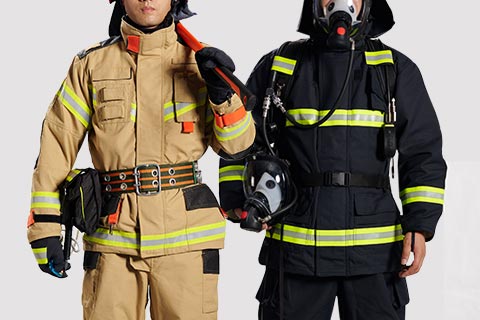

Essential Accessories Every Firefighter Helmet Should Have
The risks faced by firefighters in the fire are far more than high temperature and falling objects. Thick smoke, splashing debris, insufficient strong light and on-site noise will also affect rescue safety.As an important head protection equipment, fire helmets, in addition to their own protective performance, are also very important whether the accessories are complete, whether they are comfortable to wear, and whether they match other equipment.Choosing the right fire helmet accessories can not only make the protection more comprehensive, but also make the firefighters more calm in actual operations.
Why Are Firefighter Helmet Accessories Important?
Improve firefighter safety
The fire environment is full of high-temperature thermal radiation, splashing slag, falling debris, thick smoke and impact injuries. The main body of the fire helmet can only provide basic head impact protection.Professional fire helmet accessories can cover the face, neck, jaw, ears and other weak areas that cannot be protected by the fire helmet shell, blocking the direct invasion of high-temperature splashes, chemical liquids, and high-temperature fumes.Qualified accessories have passed flame retardant, impact resistance, and heat insulation tests to reduce the probability of accidents such as burns, foreign body stabbings, and hearing damage, and to complete the closed loop of protection. It is an indispensable part of reducing the risk of first-line casualties, and it is also an integral part of the fire protection system that cannot be ignored.Enhance comfort and visibility
Thick smoke and dark light environments will greatly compress the visual range of firefighters, and wearing heavy equipment for a long time can easily cause fatigue and sultry discomfort.The adapted fire helmet lights and reflective signs improve the field of vision under low visibility, while facilitating teammates to quickly locate each other's positions to avoid lost or accidental collisions.Lightweight and adjustable accessories optimize the force distribution of the head and reduce the pressure, friction and tingling problems caused by long-term wear. A stable wearing experience allows firefighters to stay focused and will not be distracted by discomfort. Maintain a stable state during long-term fire fighting and search and rescue operations, indirectly improving the efficiency of on-site disposal.Support different rescue tasks
Fire fighting, building collapse rescue, water rescue, mountain forest fires, and chemical leak disposal are completely different types of risks in different scenarios, and the demand for fire helmet accessories is obviously different.Basic accessories meet the immediate needs of building fire fighting, and accessories such as communication components, ear guards, and special goggles are suitable for special rescue missions.The modular accessory design supports rapid installation, disassembly and switching. The team does not need to purchase a complete set of fire helmets for each type of task, relying on the combination of accessories to switch the protection plan.The flexible accessory system adapts to the needs of multi-scene dispatch, improves the reuse of equipment, and also helps firefighting units optimize their equipment procurement budgets and realize a set of fire helmets to deal with diverse rescue missions.Essential Accessories Every Firefighter Helmet Should Have
Helmet visor
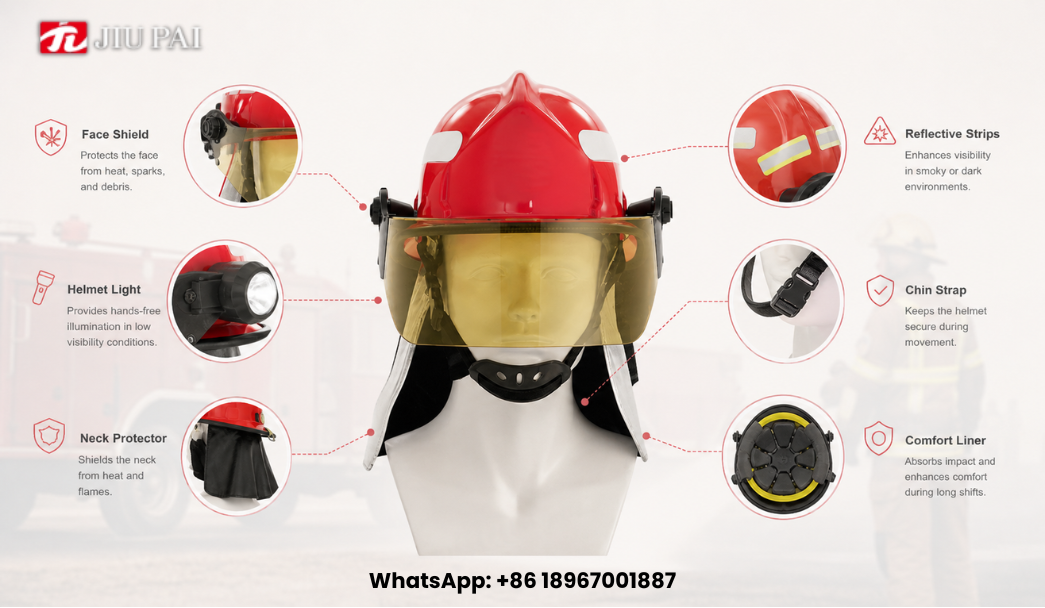
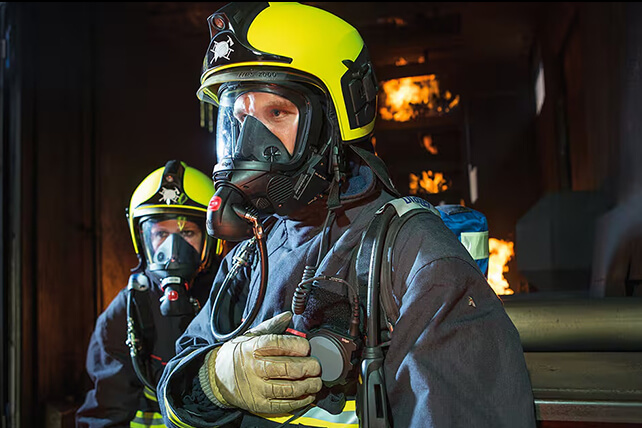
The firefighting helmet mask faces high temperature, sparks, splashing debris and corrosive liquids. It is the core accessory of facial protection and distinguishes between the two mainstream types of transparent and heat-insulating aluminum-plated models.The high-quality mask is made of impact-resistant and flame-retardant polycarbonate material, which is resistant to thermal radiation and is not easy to shatter. The overturning structure is designed so that it can be quickly put down or put away without taking off the fire helmet, taking into account the convenience of operation.When purchasing, focus on light transmittance and anti-atomization performance. Inferior masks are prone to yellowing and cracking when heated, and distortion of the field of vision will interfere with judgment.The mask cannot be squeezed and interfered with by the air respirator mask. The fit gap must be reserved to ensure that firefighters can use it normally when wearing two pieces of protective equipment at the same time.Chin strap
The chin strap assumes the heavy responsibility of fixing the fire helmet. When it hits, falls, or runs quickly, it prevents the fire helmet from shifting or falling off. Once it loosens, the head protection will directly fail.The new chin strap adopts high-strength flame-retardant webbing, with non-slip adjustment buckle, flame-retardant, no melting dripping, adjustable elastic gear, suitable for different head circumference, and soft padded style to reduce the tenderness of the lower jaw.In many accident cases, the root cause of the loss of the fire helmet is the aging, cracking, and buckle failure of the chin strap.In daily use, non-original non-standard webbing cannot be replaced at will. The inferior webbing breaks quickly in case of high temperature, and the fire helmet cannot be firmly fixed under impact conditions, which poses a major safety hazard.Neck protector
The neck is the easiest place for thermal radiation, high-temperature smoke, and splashing slag to invade. It is also a blind spot for the protection of conventional fire helmets. The protective shawl is an accessory specifically for the neck and behind the ears.Qualified neck guards are made of flame-retardant and heat-insulating fabrics such as aramid, which are resistant to continuous thermal radiation, waterproof and chemical splashing, and the edges fit closely with the lower edges of the fire helmet, leaving no protective gaps.In the structural firefighting scene, the hot flue gas flows upward, and the neck burns are very high. Neck guards can effectively block the high-temperature flue gas.The neck guard design takes into account flexibility, does not limit the rotation of the head, and is easy to clean and maintain. It is a recommended standard protective accessory for building fire disposal.Helmet lamp
Visibility in the thick smoke environment of the fire site is extremely low, and it is difficult for ordinary flashlights to free their hands. The fire helmet light is fixed on the reserved installation base of the fire helmet, and the direction of the light source follows the line of sight, which is suitable for search and rescue, demolition, and investigation of hidden dangers.Industrial-grade fire helmet lights have explosion-proof, waterproof, and high temperature resistance properties, multi-gear switching of strong light, low light, and strobe, stable battery life, and the lamp holder is anti-seismic, and will not loose and shift under impact.The interface of the lamps and lanterns needs to be matched with the original bracket of the fire helmet. Self-perforation and modification can easily destroy the structural strength of the fire helmet shell and weaken the impact resistance of the fire helmet.In confined spaces, basements, and night rescue missions, fire helmet lights are the key equipment to ensure the field of vision of operations.Ear protection
High decibel noise is widely present in fire sites, the roar of demolition tools, the impact of high-pressure water flow, abnormal noise of building structures, and the beeping of alarms. Long-term exposure can cause irreversible hearing damage.Special ear guards for fire protection are divided into two types: soundproof earmuffs and flame-retardant earplugs. The earmuffs are suitable for installation in the side slot of the fire helmet, easy to disassemble and assemble, and the flame-retardant shell can withstand short-term high temperature.Ear protection should take into account the needs of noise reduction and basic environmental listening, and cannot completely isolate teammates' instructions and dangerous abnormal noises.Ear guards are prioritized in high-noise scenarios such as chemical explosions and large-scale collapse rescue. The aging of sound insulation cotton needs to be checked regularly every day, and the severely attenuated accessories should be replaced in time to maintain noise reduction performance.Helmet goggles
firefighting helmets, goggles and masks have complementary functions, focusing on dust-proof, smoke-proof irritation, and small high-speed debris impact. They are suitable for smoke search and rescue, demolition, and dust rescue scenes.The lenses are made of scratch-resistant, anti-fog and flame-retardant materials, and the sealed frame prevents smoke and dust from entering the eyes. The storage structure can be put away upward when not in use, which does not affect the use of the mask.The goggles need to be reserved for the adaptation space of the mask and respirator mask, so that the face is not squeezed when the mask is worn, and the sealing will not fail.Ordinary civilian goggles are not suitable for fire sites, cannot withstand high temperatures, and are easy to deform and melt when heated. Special goggles that meet firefighting PPE standards must be selected.Reflective markings
Reflective signs are a low-cost core accessory for the identification and search and rescue positioning of fire personnel. They are mostly high-brightness flame-retardant reflective strips, which are attached to the fire helmet and are visible at 360°. They can identify the location of firefighters from a long distance in dark light and thick smoke environments.Qualified reflective materials are flame-retardant, do not fall off or fail in high temperature environments, do not release toxic fumes, and support customized identification and numbering as needed.In addition to the identification of teammates, the reflective logo is also convenient for on-site command and rapid inventory of personnel, which is of outstanding value in large-scale linkage rescue and wild mountain forest fires.Avoid the force buffer area of the fire helmet when pasting, do not destroy the structure of the fire helmet shell, and give priority to the original supporting reflective kit, which has more stable firmness and flame retardant properties.Helmet communication system
The communication system of the fire helmet includes an intercom pickup microphone, noise-canceling headphones, and a fixed bracket, which allows firefighters to stably receive command instructions and intercom with teammates in noisy fire areas to solve the problem of communication failure under heavy smoke and noise.The complete set of communication components is earthquake-resistant, waterproof, and flame-retardant. The pickup microphone is equipped with a noise reduction algorithm to filter the noise of demolition and water flow to ensure clear voice.The bracket adopts a non-destructive installation method, which does not damage the body of the fire helmet, and at the same time, it is necessary to avoid winding the line and hooking the external components.In chemical industry, confined space, and team collaborative search and rescue missions, communication accessories are the core equipment to ensure tactical coordination and timely transmission of early warning of dangerous situations, and they are also the key direction of upgrading modern fire fighting teams.How to Choose the Right Firefighter Helmet Accessories
Check helmet compatibility
Compatibility is the first principle of purchasing accessories. The installation slots, fixed points, and shell radians of different brands and series of fire helmets are different, and most of the accessories are not common.Priority is given to the original certified supporting accessories of the fire helmet. The original factory has undergone a complete set of combination tests to confirm that it will not loose, squeeze the lining of the fire helmet, and destroy the strength of the shell after installation.Check the model and interface specifications of the fire helmet before purchasing third-party accessories, and verify the trial installation. After installation, it will not shake, block the field of view, and affect the buffer structure of the fire helmet.Blindly purchasing general-purpose modified accessories is prone to falling off of accessories under high-speed impact, and even changes the force distribution of the fire helmet, reducing the protection level of the fire helmet itself.Consider fireground conditions
Before selecting the model, sort out the main disposal scenarios of the team, match the combination of accessories as needed, and refuse to blindly match all the accessories.The building structure should be equipped with masks, neck guards, chin straps, and reflective signs for fire fighting.Add goggles and explosion-proof fire helmet lights for collapse and demolition rescue.Upgrade chemical-resistant masks and neck guards for chemical leakage scenarios.High-noise demolition operations with ear guards.Multi-team collaborative disposal and installation of communication components.Wild mountain forest fires focus on lightweight and dust-proof accessories to reduce weight.The configuration is graded according to the scene, which not only meets the requirements of safety specifications, but also avoids unnecessary accessories to increase the weight of the head and the risk of hook-up, and balances the protection ability and operational flexibility.
Evaluate material and durability
Fire helmet accessories can withstand high temperature, friction, chemicals, and repeated shocks for a long time, and material properties directly determine the service life and protection reliability.The masks and lenses are made of flame-retardant and impact-resistant PC materials.The webbing accessories are made of aramid flame-retardant webbing, without melting and dripping.The neck protection and protective fabrics are made of aramid blended flame-retardant fabrics.The reflective strip is made of flame-retardant and highly reflective substrate.Verify the anti-aging, hydrolysis, acid and alkali resistance of accessories, moisture and chemicals, and the aging speed is faster.Don't simply choose models at low prices. Cheap materials are seemingly available in the short term, and they will deform and fail at high temperatures in a fire, which cannot provide reliable protection, and the overall full-cycle cost is higher.Follow safety standards
All fire helmet accessories must match the corresponding fire protection standards. Domestic reference to XF 44-2015 fire helmet specifications, export orders simultaneously meet NFPA and ISO related fire protection PPE standards, and products are accompanied by formal inspection reports and certification certificates.The standard clearly stipulates the performance indicators of flame retardant, thermal radiation protection, impact, and stability of accessories. Unauthenticated accessories have not been tested under fire conditions, and there are uncontrollable risks.When purchasing, the manufacturer is required to provide separate testing information for accessories, not just the certificate of the fire helmet body.At the same time, comply with the assembly restrictions in the standard, prohibit the installation of modified accessories other than the standard that are prone to additional risks, and abide by the bottom line of compliance.How to Maintain and Replace Firefighter Helmet Accessories
Inspect accessories regularly
Establish a fixed inspection ledger, conduct regular monthly inspections before and after each police incident, and check the status of all fire helmet accessories item by item.Focus on the chin with no snagging or cracks.Whether the mask and goggles are scratched or cracked.The neck protection fabric has no burning holes.Whether the reflective strip is peeling off.Whether the lamps and communication brackets are loose or not.Whether the buckle and adjustment parts are stuck and fail.Hidden locations such as the roots of the webbing and the gaps in the card slots are easy to ignore, and minor damage will expand rapidly under the high temperature impact of the fire.The inspection finds that abnormalities are marked and isolated, and it is forbidden to continue to be put into duty. The equipment administrator shall uniformly register and arrange for maintenance or replacement.Clean after each use
Residual soot, acid-base agents, and oil stains in the fire will continue to corrode the materials of the accessories and accelerate the aging. Timely cleaning after each police return is the key to prolong the life of the accessories.For cleaning, use a neutral and mild cleaning agent and a soft brush to wipe. It is forbidden to use strong corrosive solvents and high-pressure water guns to directly seal electronic accessories (fire helmet lights, communication modules).Fabric neck guards can be washed according to the instructions, fully dried, and avoid exposure to the sun. High temperature exposure will destroy the flame-retardant fibers and weaken the reflective properties.After the cleaning is completed and dried, the fire helmet is assembled back into the fire helmet. Long-term closed storage in a humid environment is easy to breed mold and accelerate the aging of the webbing. The cleaning process is simple, but it can significantly lengthen the service cycle of accessories.Replace damaged components
Accessories have any structural damage, burning marks, cracks, fabric holes, reflective failure, and broken buckles. They cannot be repaired and reused, and new products can be replaced directly.At the same time, follow the specified service life of the accessories. Even if the appearance is intact and the service life is reached, it must be forcibly replaced. The material will age naturally, and the flame retardant strength and impact resistance will continue to decay.It is easy for many teams to only change their fire helmets and ignore the simultaneous replacement of supporting aging accessories, forming a short board of protection.Replacement parts still give priority to the original products of the same model. After the replacement is completed, a trial installation test will be performed to confirm that the fixation is reliable and does not interfere with other PPE equipment, and then put it into duty.How to Ensure Compatibility Between Helmet Accessories and Firefighter PPE
Check visor and mask fit
The superimposed wearing of the mask and the air respirator mask is a high-frequency conflict point. After the assembly is completed, the test is repeated. When the mask is put down, the respirator mask will not be squeezed, and the sealing surface of the mask will not be warped. Air leakage, this is a test item directly related to life safety.The opening and closing stroke of the mask cannot interfere with the mask, and the lifting is smooth. At the same time, the lower edge of the mask and the upper edge of the respirator mask form continuous protection, leaving no gaps.The contours of different styles of respirators vary greatly. Before the new accessories are stored, the matching team will try to match the respirators one by one, record the adaptation list, and remove the incompatible combinations to avoid on-site wear and find that the seal fails and the time for disposal is missed.Ensure SCBA compatibility
In addition to the mask, the neck guard of the fire helmet, the communication cable, and the side accessories of the fire helmet may all interfere with the knapsack air respirator.Focus on checking that the back of the neck guard will not get stuck between the backrest of the respirator and the neck, causing compression and bending of the airtight tube.Sufficient margin is reserved for the routing of the communication line, and the air supply valve will not be pulled when turning or leaning over.The center of gravity of the fire helmet should also be considered. After installing lamps and communication kits, the center of gravity moves forward, which is easy to fatigue when worn for a long time, and even affects the impact force performance of the fire helmet.Do a simulation of real-life wear before purchasing in large quantities, re-engrave rescue actions such as bending over, crawling, and raising your head, and investigate all interference hidden dangers.Avoid interference with other gear
The complete set of firefighting PPE includes firefighting clothing, protective gloves, demolition tools, search and rescue positioning equipment, and firefighting helmet accessories cannot be hooked or bumped with peripheral equipment.Protruding lamp brackets and communication connectors are high-risk points. When operating in a small space, protruding components can easily get stuck in the gaps between steel bars and ruins, restricting escape movements.The outer contour of the accessories should be as simple and smooth as possible, and the cable should be fixed to reduce the free thread.Wear a complete set of equipment to simulate typical actions such as demolition, creeping through, and climbing, investigate hook-up risks, balance functional requirements and operational safety, and make a complete set of protective equipment work together and stably.Custom Firefighter Helmet Accessories for Different Operational Needs
Choose colors and markings
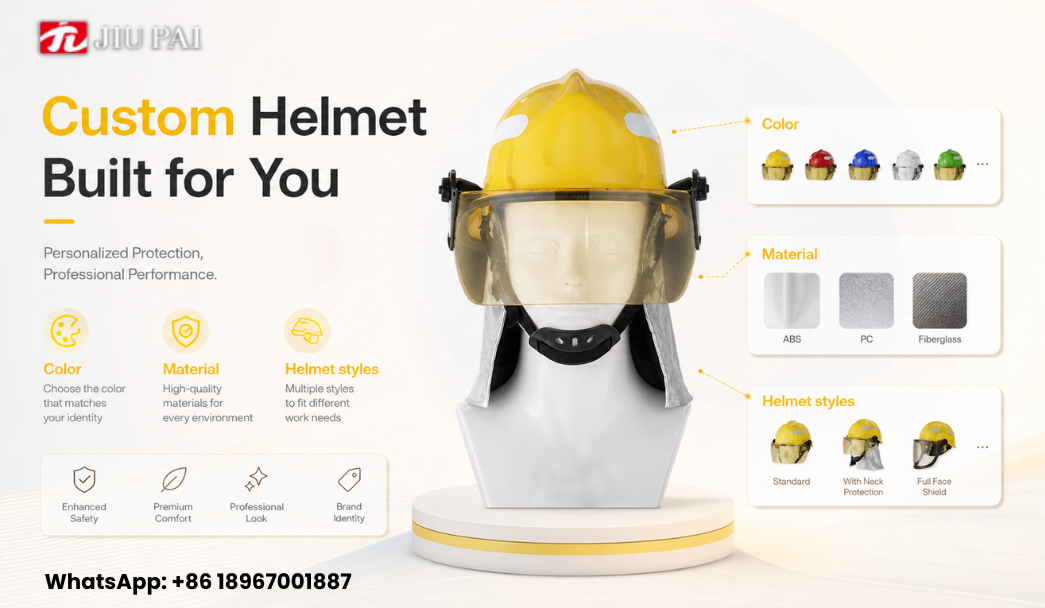
The colors of fire helmets and reflective signs can be customized as needed. Conventional firefighting red, yellow, and fluorescent green are the mainstream, and high-visibility fluorescent colors have a better recognition effect in heavy smoke environments.The identification content supports the printing of team numbers, department LOGOS, and emergency identification codes to facilitate personnel management and on-site inventory.Chemical, forest, and urban rescue teams can distinguish color schemes and quickly identify job groups.Customized reflective signs still give priority to ensuring flame retardant properties. Printing inks cannot reduce the flame retardant grade of the substrate. The layout of the signs avoids the buffer zone of the fire helmet, does not weaken the protection ability of the fire helmet, and takes into account the recognition, management needs and safety bottom line.Customize accessory configurations
The modular customization scheme supports the combination of optional accessories according to the task package, without the need to standardize all components across the board.Basic fire extinguishing kit for urban buildings, face mask, chin strap, neck guard, reflective strip.Dismantle the search and rescue upgrade package, add explosion-proof fire helmet lights, anti-fog goggles, and ear guards.The collaborative command package superimposes noise reduction communication components.The manufacturer can adjust the installation point of the accessories, the position of the bracket, and the wiring scheme to adapt to the team's existing PPE models.When customizing the configuration plan, the assembly guidance list and inspection form are provided simultaneously to facilitate the daily management of equipment administrators, and the flexible modular plan is adapted to the procurement needs of firefighting units with different budgets and different combat directions.Work with a reliable manufacturer
Choosing a source manufacturer with a full set of firefighting equipment production qualifications and complete testing capabilities is the core of the long-term stable supply of accessories, safe and controllable.Reliable manufacturers can provide integrated supporting solutions for the body of the fire helmet + a full set of accessories, do a unified compatibility test, and issue a complete set of test reports to reduce adaptation disputes caused by multi-party procurement.At the same time, it supports small-batch samples, on-site trial installation, and technical docking. There are continuous supply channels for accessories after sales, so there is no need to worry about discontinued parts.As a professional firefighting equipment manufacturer, we can provide standard and customized firefighting helmet accessories, and cooperate with customers to complete the whole process of selection verification, qualification document delivery, and batch delivery services.Conclusion
Fire helmet accessories seem to be only auxiliary equipment, but they directly affect the protection effect and operating experience of firefighters in complex environments.From masks and neck guards to helmet lights and communication systems, each configuration needs to be reasonably selected in accordance with actual rescue needs.For fire fighting teams and bulk buyers, in addition to paying attention to the quality of the accessories themselves, they must also pay attention to the compatibility with helmets and complete sets of PPE.Jiupai Safety focuses on the manufacture of firefighting protective equipment, provides customized services for firefighting helmets and supporting accessories, supports OEM and ODM, and helps customers create firefighting protection solutions that are more suitable for actual operational needs.FAQ
Are firefighter helmet accessories universal?
Most of the fire helmet accessories are not common, and there are differences in the installation interface and shell structure of different brands and models.Before purchasing, the helmet model should be confirmed and the compatibility test should be done to avoid failure to install or affect the protective performance.Can helmet accessories be replaced separately?
can.Chin straps, masks, goggles, neck guards, helmet lights, etc. usually support separate replacement, but the original accessories of the same specifications should be selected, and the installation should be checked for firmness after replacement.Which accessories are required for structural firefighting?
Structural fire extinguishing usually requires basic accessories such as masks, chin straps, neck guards and reflective signs. Helmet lights, goggles, ear guards and communication equipment can also be added according to on-site needs.How often should helmet accessories be inspected?
It is recommended to check the status of accessories before and after each alarm, and conduct regular comprehensive inspections.When cracks, burns, loosening or aging are found, they should be replaced in time to ensure protective performance
Last Article:
Request A Quote
Related News

Quick Consultation
We are looking forward to providing you with a very professional service. For any
further information or queries please feel free to contact us.