
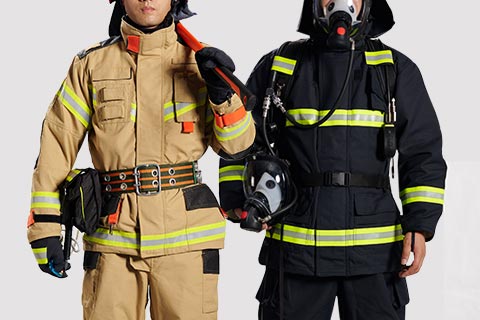

2026 Guide to Choosing a Firefighting Suit Manufacturer in China
The core difficulties of cross-border firefighting clothing procurement focus on issues such as uneven fabric quality, difficult to distinguish the authenticity of international certification, unstable factory production capacity and quality control, irregular customized services, and unsecured delivery and after-sales.As a high-risk protective equipment to protect the lives and safety of front-line personnel, the procurement of firefighting clothing must not rely solely on low-cost screening.Procurement selection needs to focus on core core qualifications, production strength, customization capabilities and delivery after-sales system, accurately identify high-quality manufacturers, and avoid quality hidden dangers and procurement risks from the source.
What Materials Are Used in Firefighting Suits?
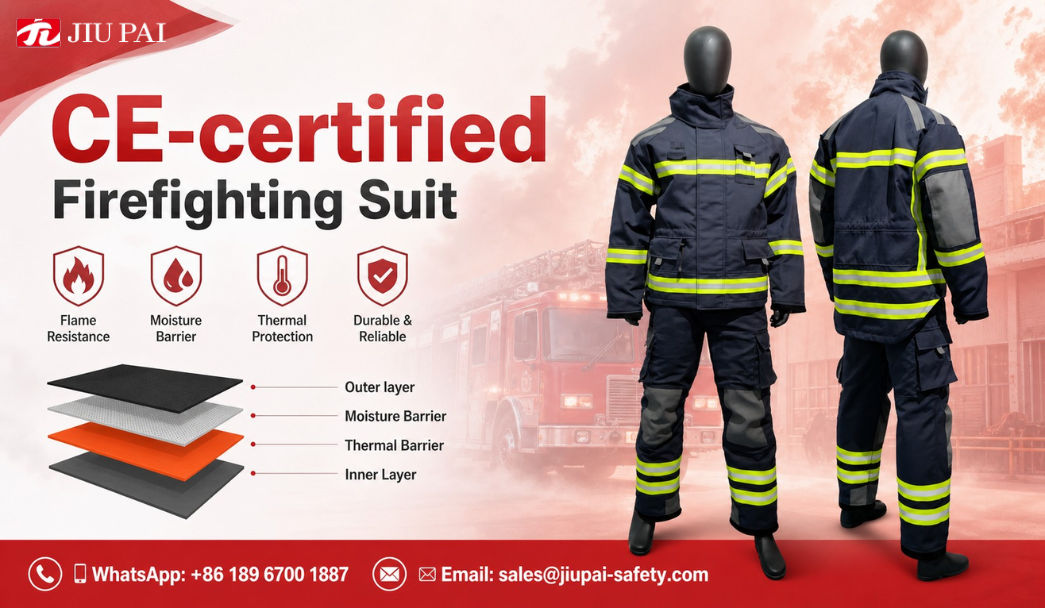
Outer shell fabrics
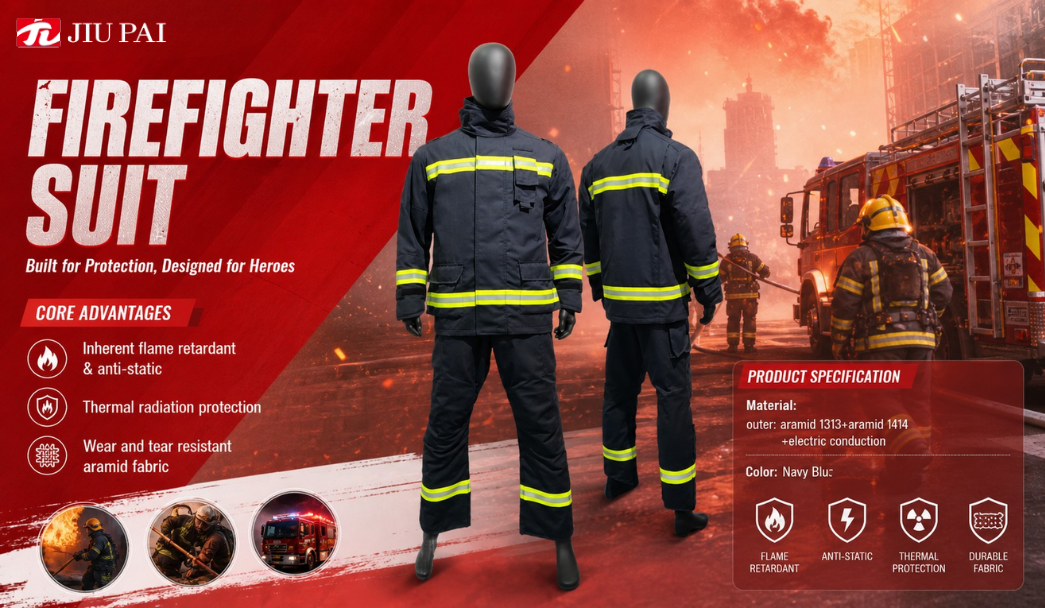
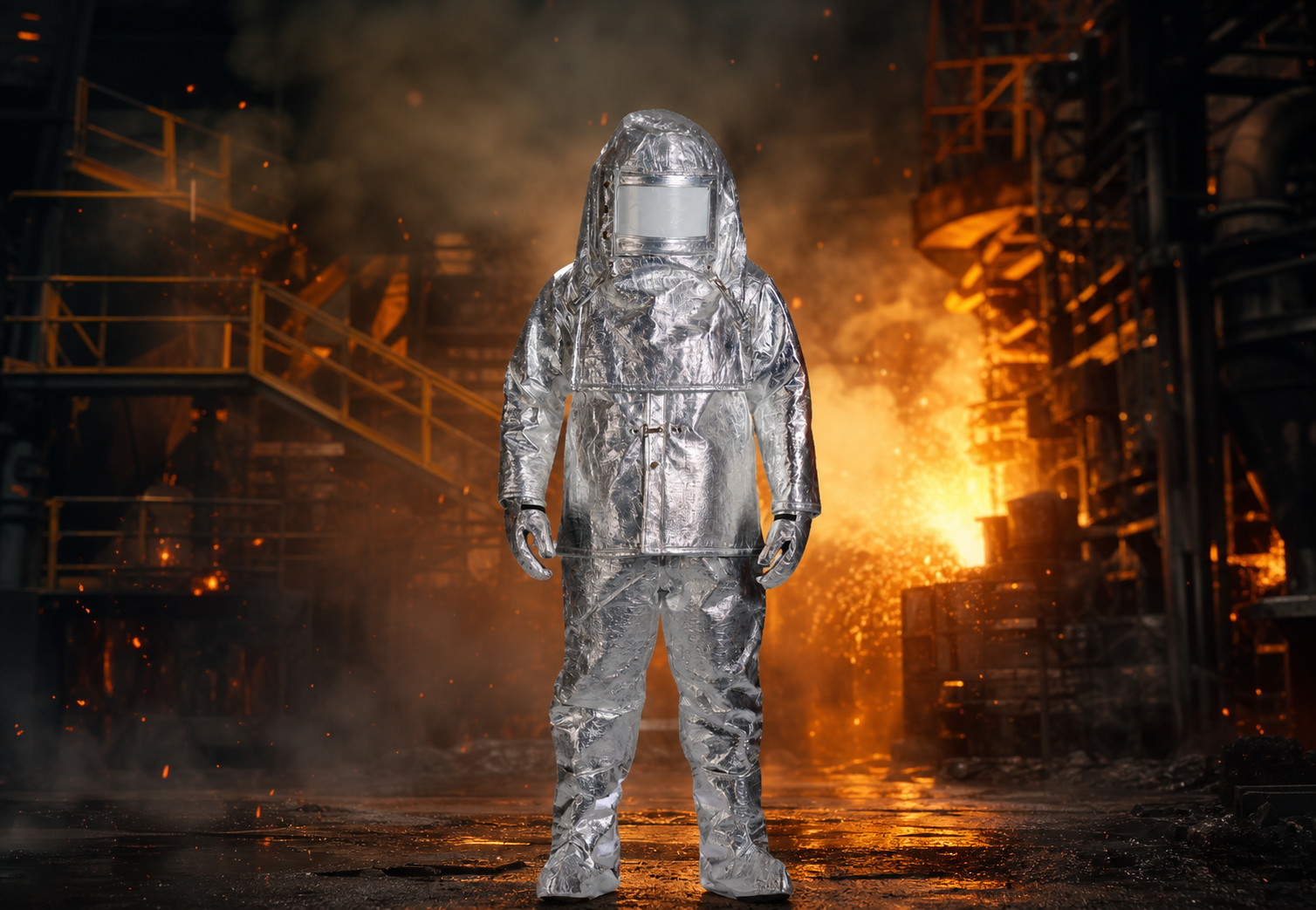
The outer fabric is the core first protective barrier for firefighting clothing to face open flames, high temperature roasting, mechanical friction and sputtering of chemical reagents, which directly determines the basic safety performance and service life of the clothing.High-quality finished products in the industry generally use high-end flame-retardant aramid blended fabrics, which can perfectly balance stable flame retardant, high-strength tear resistance and wear resistance.When purchasing and selecting models, we need to focus on the washing resistance of fabrics. After multiple cleaning, the flame-retardant and wear-resistant properties of high-quality fabrics will not be greatly attenuated.Inferior manufacturers commonly use ordinary post-finishing flame-retardant fabrics, which meet the standards in the short term but can easily fail, and there are great safety risks in long-term use.Moisture barriers
The water-proof breathable film is the core middle-layer functional material of firefighting clothing. It is mainly used to block the penetration of liquid water, high-temperature water vapor and corrosive chemical liquids in the fire site, while quickly discharging sweat and moisture generated by human operations to achieve a two-way balance between waterproof and breathable.If the sealing of the barrier is not up to standard, harmful liquids and high-temperature water vapor will penetrate the fabric and burn the skin; if the breathable performance is insufficient, long-term wear will cause internal sweat and sultry heat, greatly increasing the burden on firefighters.When purchasing and inspecting, it is necessary to focus on verifying the core parameters of the material such as water pressure resistance and air permeability to ensure that it is fully adapted to various fire operation scenarios.Thermal liners
The thermal insulation lining is the key structure to isolate thermal radiation and conduct heat. It can effectively block the transmission of high temperature from the fire to the human skin. It is the core inner layer configuration to protect the safety of the wearer.The protective effect of the lining is not determined by the thickness alone. Too thick lining can cause clothing to be bulky, poor heat dissipation, and restrict physical activity; insufficient thickness can not achieve the standard heat insulation effect, and it is difficult to resist high temperature invasion.The regular high-quality thermal insulation lining adopts a multi-layer non-woven flame-retardant felt composite process, which maintains continuous and stable thermal insulation performance on the basis of strict control of the overall weight of the garment. At the same time, the fabric is soft and skin-friendly, ensuring the flexible operation of firefighters.Reflective and protective components
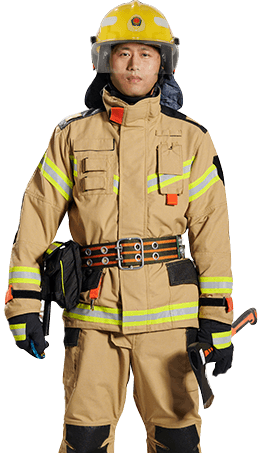
Reflective protective accessories are an indispensable auxiliary protective structure for firefighting clothing, covering various accessories such as high-visibility reflective strips, flame-retardant zippers, wear-resistant velcro, high-strength sutures and force-reinforced patches.Most buyers can easily ignore the quality of accessories, but in the high temperature and complex environment of the fire site, ordinary accessories are prone to melting, shedding, thermal conductivity and other problems, causing safety accidents.All firefighting suits are equipped with high-temperature and flame-retardant reflective tape, all metal hardware accessories are treated with heat insulation and protection, the whole line is sewn with flame-retardant yarns, and the key force joints are fully reinforced, which can withstand high-intensity fire operations and eliminate the risk of damage and failure.Which Fire Suit Standards and Certifications Should Be Checked?
EN ISO 13688:2013+A1:2021
EN ISO 13688:2013+A1:2021 is an important general standard in the field of European protective clothing. It mainly stipulates the basic requirements of protective clothing in terms of ergonomics, harmlessness, size identification, clothing identification and information provided by manufacturers, and develops unified basic specifications for different types of protective clothing.For the procurement of firefighting clothing, this standard helps to determine whether the product meets the corresponding requirements in terms of basic safety, wearing applicability and product identification.When purchasing firefighting clothing, it is recommended to verify whether the product meets its corresponding professional protection standards at the same time, and confirm the integrity of the relevant test reports and certification documents.Jiupai Safety's firefighting clothing products meet the requirements of corresponding European standards and have CE certification to provide customers who need to enter the European market with compliant products and certification support.EN 469 requirements
EN 469 is the EU's unified authoritative core standard for firefighting protective clothing. It comprehensively regulates a number of core test indicators such as flame-retardant, heat-resistant, tear-resistant, chemical-permeable, waterproof, breathable and overall adaptability of firefighting clothing. It is a hard entry requirement for entering the European market.The standard is divided into multiple performance levels according to the operation scenario, and is suitable for different operating environments such as indoor closed fire fighting, outdoor open fire disposal, and high temperature rescue.When docking European purchase orders, it is necessary to strictly verify the overall compliance of the finished products, so as to eliminate unqualified products that only the individual fabrics meet the standards and the finished products as a whole do not meet the EN 469 grade specification.CE certification
CE certification is the statutory compulsory access qualification for firefighting clothing to enter the EU market. Since firefighting clothing belongs to the three types of high-risk PPE personal protective equipment, a certification certificate must be issued by an officially authorized notified body of the European Union before customs clearance and listing can be completed.At present, there are a large number of self-made and self-declared invalid CE documents in the industry, which do not have any customs clearance and market compliance effects.When purchasing and docking, it is necessary to verify the notified body number, valid product coverage and validity period corresponding to the certificate one by one, and resolutely abandon informal certification documents to ensure the smooth customs clearance and sales of products.Jiupai PPE Supplier's firefighting clothing have obtained CE certification and are equipped with corresponding compliance documents to provide reliable certification support for customers entering the European market and help products meet customs clearance and market sales requirements more smoothly.Test reports and product documentation
Third-party inspection reports and complete product technical documents are an important basis for firefighting clothing quality compliance and traceability, and are of the same importance as certification certificates.There will be subtle differences in the protective performance parameters of different fabric batches and different styles of finished products from the same manufacturer, and a single certificate cannot cover all products.Formal and compliant manufacturers can provide complete and effective third-party inspection reports for a single finished product, and at the same time provide a full set of technical information for firefighting clothing, including material lists, production parameters, usage specifications and maintenance instructions, which can fully meet the needs of overseas customs clearance, customer reporting and product traceability throughout the cycle.How to Evaluate a Firefighting Suit Factory
The paper certificate and sample performance cannot fully represent the quality stability of mass production.To evaluate a firefighting clothing manufacturing plant, it is necessary to comprehensively judge the hardware facilities, quality control processes, production capacity scale, and factory inspection conditions, and select partners with the ability to produce high-risk protective equipment on a large scale.Production facilities
Professional firefighting clothing production requires extremely high equipment and production lines. Special production equipment is the basic condition to ensure the stable quality of finished products, which is different from ordinary clothing processing and production lines.Regular factories are equipped with professional precision cutting equipment for flame-retardant fabrics, composite processing equipment for multi-layer protective fabrics, special flame-retardant sewing stations and hot-pressing and setting equipment for accessories, which can accurately control the core processes such as multi-layer composite and sealing strips.Ordinary garment processing plants lack special processing equipment and technological standards, and fabric compounding is prone to problems such as layering, glue opening, and lax sealing, which cannot meet the safety production standards of firefighting clothing.Quality control process
A perfect quality control system runs through the whole process of firefighting clothing production, from the warehousing of raw materials, the production of processes to the outbound of finished products, to achieve a full range of quality inspection and control without dead ends.When raw materials are stored, the core properties of flame retardant, wear-resistant, and tear-resistant fabrics and accessories are sampled batch by batch to prevent inferior raw materials from being stored; multiple process inspections are set up in the production process, focusing on controlling the accuracy of key processes such as sewing, laminating, and striping; after the finished firefighting clothing is completed, batch sampling and testing are carried out to verify the appearance, size, assembly of accessories and protective performance, effectively avoiding quality fluctuations in mass production.Production capacity
Capacity assessment is a key part of screening reliable firefighting clothing manufacturers. It is not only necessary to verify the monthly and annual output scale of finished products of the factory, but also to pay attention to the stable stocking capacity of core raw materials and accessories.Many small factories can produce high-quality samples, but after undertaking large-volume orders, they will replace low-cost and inferior raw materials privately in order to reduce costs, resulting in serious discrepancies between the quality of large-scale goods and the samples.In the early stage of procurement, it is necessary to verify the factory's past large-volume order delivery cases and supply chain reserves, and judge the factory's production capacity and carrying capacity based on its own order level to ensure that the quality of large-volume orders is unified and delivered on time.Factory inspection
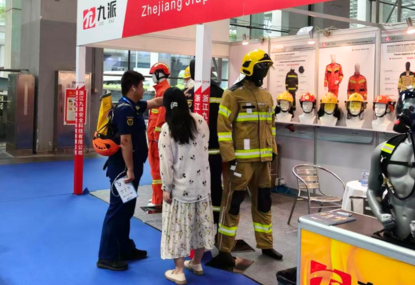
Factory inspection is the core means to avoid middlemen and ensure the authenticity and reliability of production strength. It is mainly divided into two mainstream methods: online video factory inspection and third-party on-site factory inspection.Before confirming the cooperation, it is necessary to verify the actual production workshop, raw material storage area, finished product warehouse and professional testing laboratory of the factory on-site or online to intuitively understand the production control situation.At the same time, the factory's past customer inspection records and qualification information can be requested, and the standardized production management system of high-risk protective equipment can be checked, and the situation of trade middlemen posing as physical production factories can be accurately screened to avoid cooperation risks.
What Customization Options Should a Manufacturer Offer?
Fabric and color selection
Under the premise of meeting international safety standards, professional firefighting clothing manufacturers can provide a variety of fabric and color customization options to meet the procurement needs of different regions and scenarios.The fabric covers a variety of certified flame-retardant materials, forming a differentiated gradient in terms of gram weight, wear resistance, lightness, protection level and procurement cost, and can be flexibly selected.In addition to the industry-common navy blue, fire orange and infrared colors, it supports a variety of compliance dyeing customization. All customized fabrics have been strictly tested, and the dyeing process will not destroy the original flame retardant, heat insulation and other core protective properties to ensure compliance and personalization.Sizing and design
There are obvious differences in the body size of people in different countries and regions, and standardized fixed sizes cannot be adapted to the needs of all overseas markets.The high-quality firefighting clothing factory has flexible size and structure customization capabilities, and can optimize the size parameters according to the body shape data of the target market to fit the local wearing habits.At the same time, it supports personalized adjustment of clothing structure details, including pocket layout, elastic structure of cuffs and hems, and detachable lining design, which greatly improves wearing comfort and ease of operation. All structural changes strictly follow the protection standards and do not weaken the core protection capabilities of clothing.Logo and branding
Brand logo customization is an important content of personalized customization of firefighting clothing. Mainstream manufacturers support a variety of logo processing techniques such as thermal transfer printing and high-precision embroidery to meet the display needs of different brands.Logo processing technology has strict compliance requirements, and all processing operations shall not damage the structure of the outer flame-retardant fabric to ensure that the protective performance of the fabric is not degraded.At the same time, the customized brand logo must have the characteristics of high temperature resistance, washing resistance, and non-shedding, and can be adapted to the high temperature operating environment of the fire site.The factory will evaluate the feasibility of the customized plan in advance to avoid the safety risks caused by process changes.OEM/ODM production
As A mature firefighting clothing manufacturer, JIUPAI firefighting suit manufacturer can provide professional OEM and ODM two-way production services, which are fully adapted to the customized needs of different buyers.The OEM model relies on the drawings, samples, and technical parameters provided by customers, and accurately reproduces the production in strict accordance with customized standards to ensure that the finished products are highly consistent with customer needs.The ODM model relies on the factory's own R&D team and mature version library to provide customers with original style design, optimization and upgrade services.When choosing ODM customized products, it is necessary to confirm that the finished product after the facelift has passed the corresponding international standard testing to ensure that the product is in compliance and available.What Should Buyers Ask Before Placing an Order?
MOQ and lead time
Before placing an order, the minimum order quantity and the overall delivery cycle need to be clearly verified. This is the key business parameter to ensure the smooth progress of the procurement project.The product MOQ will be flexibly adjusted according to the fabric inventory status, customization difficulty, and process complexity. The MOQ of conventional spot fire suits is lower, and the MOQ of in-depth customized styles is higher.At the same time, it is necessary to split and confirm the proofing cycle, the large-scale production cycle, and the delivery and stocking cycle, fully consider the out-of-stock of raw materials, logistics delays and other emergencies, and reserve sufficient delivery buffer periods to accurately match the project landing time nodes.Sample availability
Sample verification is the core step to control the quality of firefighting clothing and avoid the risk of large-scale goods. It can intuitively verify the fabric material, process details and protective performance.Before purchasing, you need to confirm the sample specifications, proofing costs, and delivery cycle, and give priority to applying for samples of the same style, material, and process as subsequent large-scale products, so as to eliminate the industry chaos of high-quality samples and large-scale products cutting corners.After receiving the samples, it is recommended to entrust a third-party authority to carry out special testing, focusing on the verification of core protection indicators such as flame retardant, heat insulation, and waterproofing, and then start bulk procurement cooperation after confirming that the standards are up to standard.Testing and inspection
Before bulk procurement, it is necessary to clearly agree on the inspection and acceptance mechanism of finished products to ensure that the quality of large-scale goods is in compliance and controllable.You can confirm the inspection form in advance, choose the whole process of factory self-inspection or door-to-door sampling inspection by a third-party authority, lock in the inspection items and acceptance standards approved by both parties, and fully cover key indicators such as the core protection, process, and size of CE-certified firefighting clothing.At the same time, define the rectification, return and exchange plans for unqualified product testing in advance, clarify the rights and responsibilities of both supply and demand, effectively avoid quality disputes after mass production, and ensure the stable landing of purchase orders.Packaging and delivery
Packaging and logistics delivery are important links in cross-border fire service procurement, which directly affect the integrity of the goods and the timeliness of delivery.It is necessary to confirm the standardized packaging plan in advance, including single-piece protective packaging, outer box specifications, compression protection design and customized marking services, which are suitable for different cross-border transportation scenarios such as sea and air transportation.At the same time, clarify the place of delivery and trade terms, sort out the division of rights and responsibilities such as logistics and transportation, customs clearance, tax and fee payment, and accurately estimate the time limit of transportation to avoid damage to the goods, delay in arrival and other issues affecting terminal sales and project delivery.After‑sales support
As a special high-risk protective equipment, firefighting clothing, perfect after-sales support is the core guarantee of long-term cooperation, far beyond the scope of return and exchange services for ordinary products.Regular manufacturers can provide a full set of product technical information, wear and maintenance teaching materials to help end users standardize the use of products.In view of the process defects of mass production, it can provide efficient rectification and after-sales compensation plans. At the same time, it supports the replenishment service of consumables such as reflective strips, accessories and accessories, and provides stable support for late product maintenance and iterative replenishment to ensure long-term compliance with product use.Conclusion
The selection of Chinese firefighting clothing manufacturers cannot be based solely on quotation as the core judgment basis.Qualified suppliers need to have a compliant material system, complete and effective international certification, a mature and stable production and quality control system, and at the same time can match reasonable customization, reliable delivery and after-sales guarantee.The purchaser shall put protection and safety first, systematically verify the fabric configuration, the validity of the certificate, and the true strength of the factory, and do a good job of sample verification and information confirmation before placing the order.Only by doing a good job of preliminary screening can we find a long-term and stable partner in the manufacture of firefighting clothing to ensure the safety of end users.
Request A Quote
Related News

Quick Consultation
We are looking forward to providing you with a very professional service. For any
further information or queries please feel free to contact us.